
History of the Leland Street Cooperative Garden - Part One - 1982 to 2008
Written by Kathleen Robinson
Chapter One: Before There Was a Garden
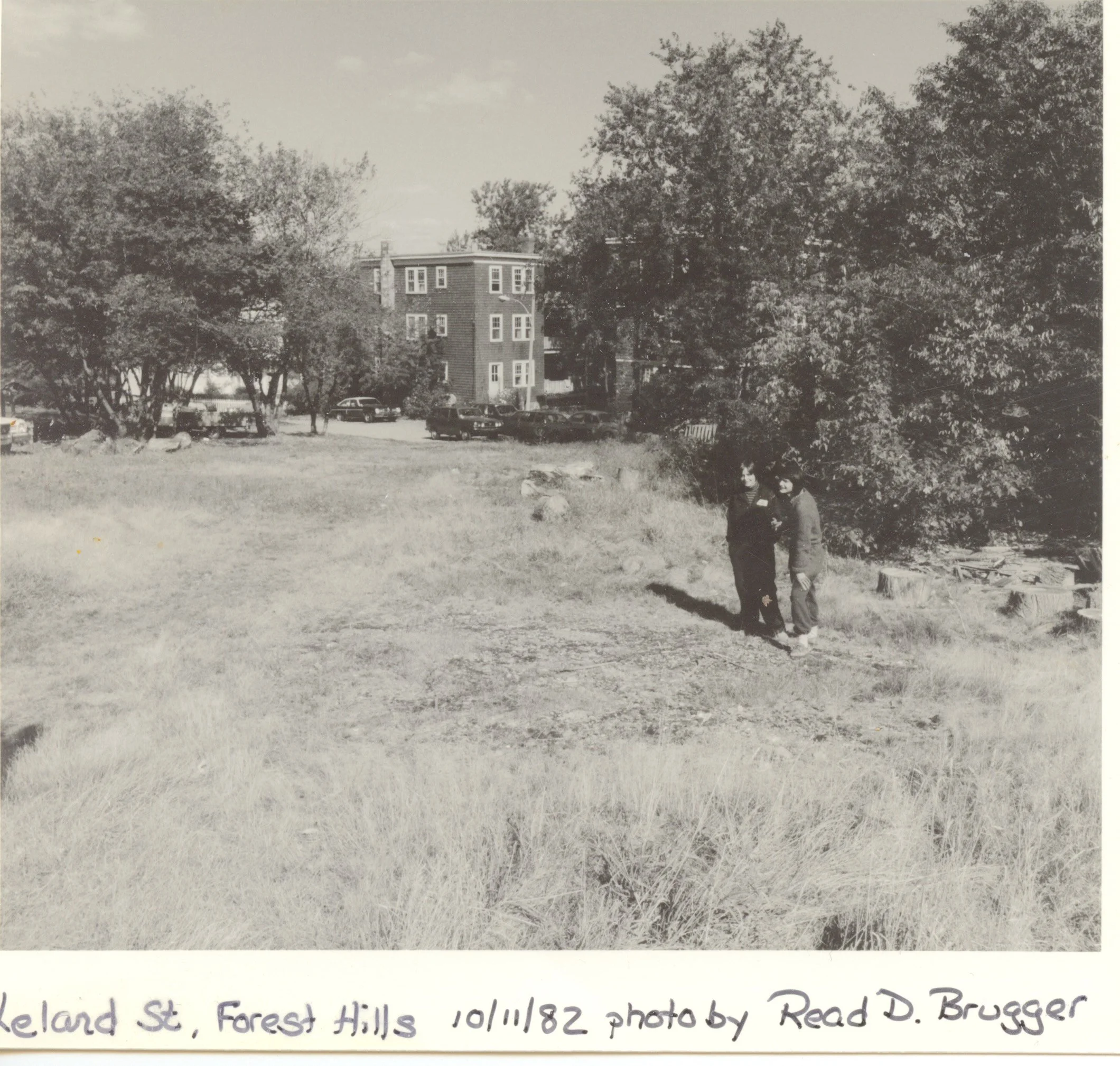
Before there was a garden. Taken 10/11/1982. Photograph by Read D. Brugger
When I moved into the Forest Hills neighborhood in the early 1980s, it was very different from what it is today. Many homes were in a deteriorated condition after years of neglect by absentee landlords and poverty-stricken homeowners. The neighborhood was part of, or at least on the edge of, a large area of Boston which in the public mind was simply dangerous. For decades it had been assumed by many that no one would live in this area if they had a choice, and the City of Boston had invested nothing in it beyond maintaining basic services. It was hard to sell or buy homes in Forest Hills, because it was part of a redlined district where homeowners’ insurance was not easily available. Neighborhoods near Forest Hills in Dorchester and Roxbury were experiencing waves of arson, as landlords, unable to sell their properties, simply burned them for the insurance money.
In this atmosphere, vacant lots that either had never been built on, or that were sites of homes that had burned, were virtually worthless. No one considered building new houses here. Many vacant lot owners simply stopped paying taxes to the City and forgot about their properties. Three such abandoned lots occupied the dead end of Leland Street, off Wachusett Street, abutting Forest Hills Cemetery. These parcels had never been built on, probably because Roxbury puddingstone ledge lay close to the surface throughout much of the site. They had been used for years as a place to dump construction waste and junked cars. When I moved here in the early 1980s, the site was a forest of Japanese knotweed, that indestructible plant which, along with cockroaches, will probably inherit most of Boston if a natural or manmade disaster destroys all other life forms. The Lots, as they were referred to by nearby neighbors, had also become a venue for drinking, drug dealing, and other illicit activity. When I first moved to a nearby house, most neighbors avoided walking into, or even near, the Lots.
The first step in the long journey of transforming the Lots into the Leland Street Community Garden came when some of the nearby neighbors decided we needed to actually go into them so that those using them for criminal purposes could no longer have possession by default. We organized a few neighborhood cleanup days and made a small start on removing years’ worth of trash. I remember that a few times neighbors brought picnics into the Lots. On one of those occasions, a young man unknown to us walked past, carrying an unboxed television set. He brazenly took it to the cemetery fence and hoisted it over to another young man waiting on the other side. One of the astounded picknickers exclaimed, “So that is the meaning of the term ‘to fence’!”
During these early cleanup days in the Lots, neighbors began to talk to one another about possible community uses for the space. Exhilarating ideas were floated: a windmill to create a non-grid source of electricity for our neighborhood, or perhaps a well or community greenhouse. Even though property values in Forest Hills and nearby neighborhoods had been stagnant or declining for many years, it was clear in the early ‘80s that some people were interested in reviving the area. The City of Boston had begun organizing auctions to sell some of the vacant parcels of land it had inherited by default of tax payments. One neighbor, a community organizer working in an arson prevention program, encountered an individual whose property insurance was about to be canceled because of his arson record. He showed up on Leland Street, as it turned out, because he owned the vacant lot to the side of 15 Leland Street, and was considering acquiring the Lots to build condominiums there. This increased our sense of urgency. We began to realize that if we wanted the Lots to remain a public open space, we, the neighbors, needed to find a way to own them.
Some homeowners and tenants in homes abutting the Lots formed a group to explore purchasing them. We approached the Boston Natural Areas Fund (BNAF) – then a fledgling land trust organization with a mission to preserve public open space in Boston – for advice. They suggested that they could purchase the Lots and lease them to our community group for a very small dollar amount. In 1983 BNAF purchased the Lots, ensuring that they would remain “green and open to the public forever.” Eventually, the community gardeners arranged with BNAF to use the space without charge as long as we maintained it as a garden.
For the first few years after the BNAF purchase, the work of developing a community garden proceeded rather slowly, in fits and starts. We had more work to remove trash. We finally got the City to remove the junked cars. We dug and dug and dug at the tenacious knotweed. (On a side note: my son, who was a teenager at the time, became an obsessive-compulsive knotweed digger. Apparently, this condition is never outgrown, as on a recent visit from his home in California, he spent time in Franklin Park digging at the knotweed, which is threatening the forests there.) We even tried to eliminate the knotweed by weed-whacking it and then covering the stubble with layers of old carpeting. This effort failed because it only encouraged the plant to spread its roots beyond the carpeted area and spring up in spaces which had previously been free of the menace.
The first actual gardening on the Lots began when one neighbor turned over the soil in a spiral pattern in a spot where the knotweed removal had been relatively successful and planted corn. The following year another neighbor planted herbs – basil, sage, marjoram, and lavender – in the spiral. With this delightful innovation, the idea of a community herb garden was born. In those early years, we also obtained and planted several small fruit trees – apple, pear, and beach plum. The Fruition Program of UMass Extension Service provided these trees, which the community organization Earthworks later took over. Most of these trees are still living and producing fruit, although few people are aware of them or take advantage of the harvest.
Chapter Two: Building the Garden, 1989-1990
In 1988, the development of a community garden on the Lots got a huge boost when we applied for a $25,000 grant from the Grassroots Program of the City of Boston Public Facilities Department. This was federal money for improvement projects in “inner city” areas and administered by the City. Our proposal called for the building of a fieldstone wall to separate the parking area at the end of Leland Street from the Garden, removal of dead and weed trees, planting of specimen trees and shrubs, construction of cobblestone herb beds in the Celtic cross pattern, building raised beds for plant propagation and/or growing vegetables, and a three-bin compost system. We received the Grassroots grant in 1989 with the stipulation that the plan must be realized and the entire grant spent in one year.
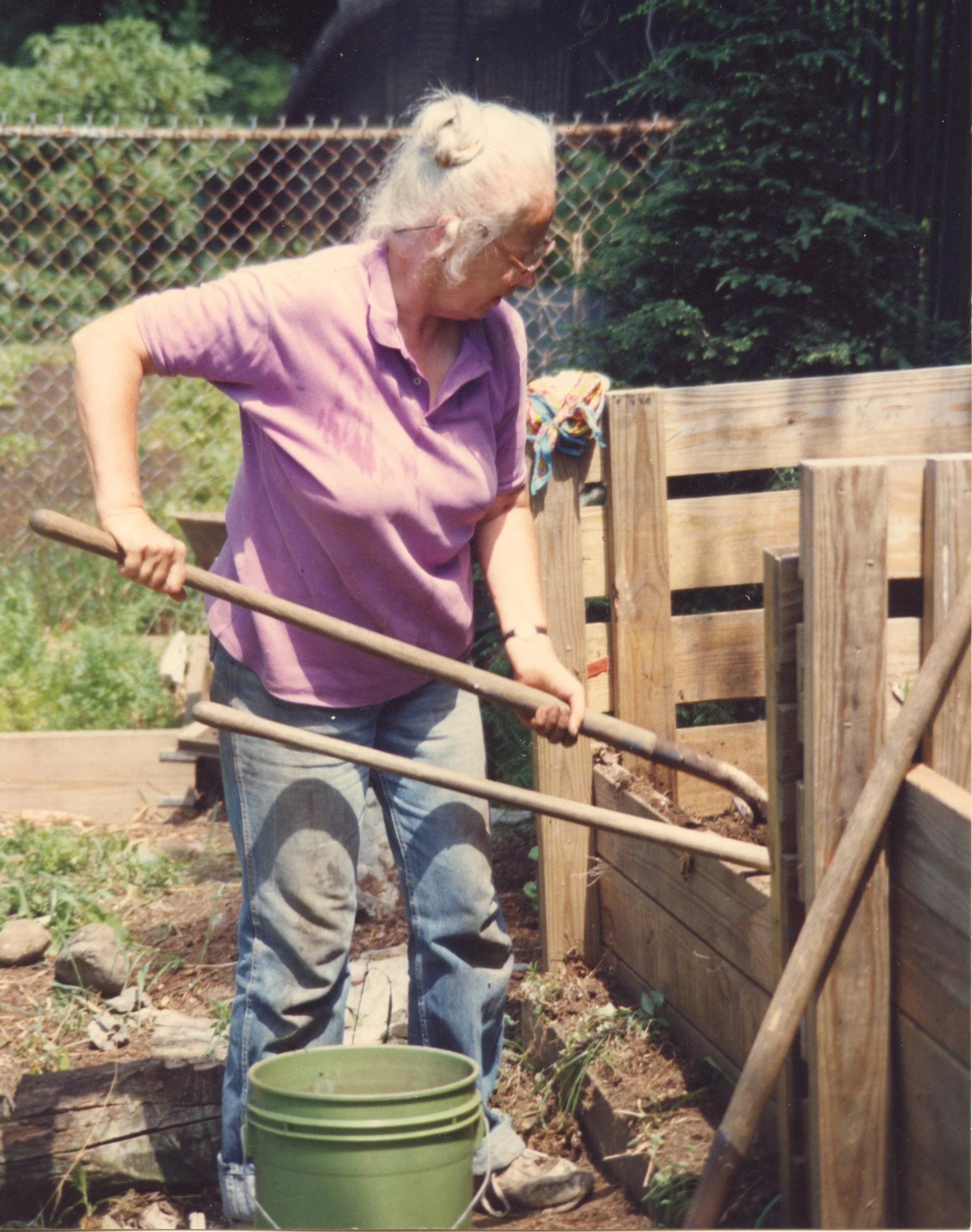
Lynn Gaylord turns compost in the newly built compost bins, circa 1990
This initiated months of hectic activity in which more neighbors than ever enthusiastically participated. During the spring, summer, and fall of 1989 and 1990, we held work days almost weekly. Many hours were spent sifting soil to remove rocks and glass and trucking leaf mold from Forest Hills Cemetery. The front wall (of rip-rap design), the cobblestone herb beds, the raised beds, and a stone wall at the back of the White Garden were built. They planted many shrubs and perennial plants. Neighbors oversaw grading work by a backhoe owner and tree work by licensed arborists. During the year of garden building on Leland Street, activity was so intense that a monthly newsletter called The Lots Review, edited by a neighbor who was a law student, was distributed to all neighbors to let everyone know what was going on.
One reason that so many neighbors – often 10 or 15 including several children on a given work day – got involved in building the Leland Street Garden, was that they had helped to plan it. Shortly after we received the Grassroots grant, we hired a local landscape architect to help create a detailed plan. She led several community meetings where neighbors were invited to submit their own drawings and written lists of ideas for the community garden. She consolidated many of these ideas into the blueprint for the Leland Street Garden. The decision to build an open community space with garden areas jointly maintained, rather than individual plots, was made partly because the underlying ledge throughout much of the space made it infeasible to have many vegetable-growing plots. Also, a number of neighborhood kids had been playing in the Lots for years and were active participants in the garden building. It didn’t seem right to fence them out and give access only to plot holders. In the design meetings, many neighbors expressed the desire for a lawn area where kids could play, and where we could hold neighborhood parties and events.
Although enthusiasm in the neighborhood for creating a community garden was high after we received the Grassroots grant, support for the plan was not absolutely unanimous. A small minority of residents in abutting homes (actually two or three people) opposed the idea of a public open space. From their point of view, creating an open garden would only encourage the “wrong kind of people” to come and would make the neighborhood more dangerous. They felt the garden should not be open to the public but rather fenced in with access given only to designated gardeners. Though only a very few neighbors held this view, they were adamant and tried hard to stop the project. They discovered in researching official City maps that Leland Street technically went all the way back to the Cemetery fence – even though it had probably never actually extended across the Lots. Since it was illegal to build a wall across a street, they claimed they could legally prevent our construction of the wall planned as a demarcation between the street and the Garden.
Because of the threats of the minority of obstructionists, we changed the plan, deciding to build not a vertical wall but instead a “rip-rap wall,” by laying large fieldstones flat on a graded rise at the end of Leland Street, and planting low-growing, ground-cover plants between the stones. This was one of the first garden construction projects to be completed, and I remember how elated we ten or so neighbors who worked on it felt when it was done. Our garden really was going to happen! Throughout the building process, there was a sense of empowerment. Time and again we were amazed at how quickly four or five people working together could complete jobs that seemed overwhelming for one or two people working alone. By the time of the Grand Opening party for the Garden in June 1990, those few neighbors who had opposed it had moved away.
Chapter Three: The Opening Years of the Garden, 1990-1991
By June 1990, we had spent the Grassroots grant money, and the garden-building phase was mostly finished. A Grand Opening Party was held, complete with a cake decorated with edible flowers and tea from garden herbs. Neighbors who had worked hard building Leland Street Community Garden invited friends and family members to celebrate our accomplishments. Mary Milligan, then president of the New England Herb Society, who had given much advice and encouragement and donated plants from her own garden, attended. Bud Hanson, vice president of Forest Hills Cemetery, gave a short thank-you speech and promised continuing cooperation with the gardeners. The star of the day was a six-year-old neighbor, who had devoted many hours to building and planting the garden. He was enthusiastically applauded when he announced proudly and somewhat incredulously that we had a tree in our garden that made pears, and that he had planted some plants that would soon be making free tomatoes for all of us.
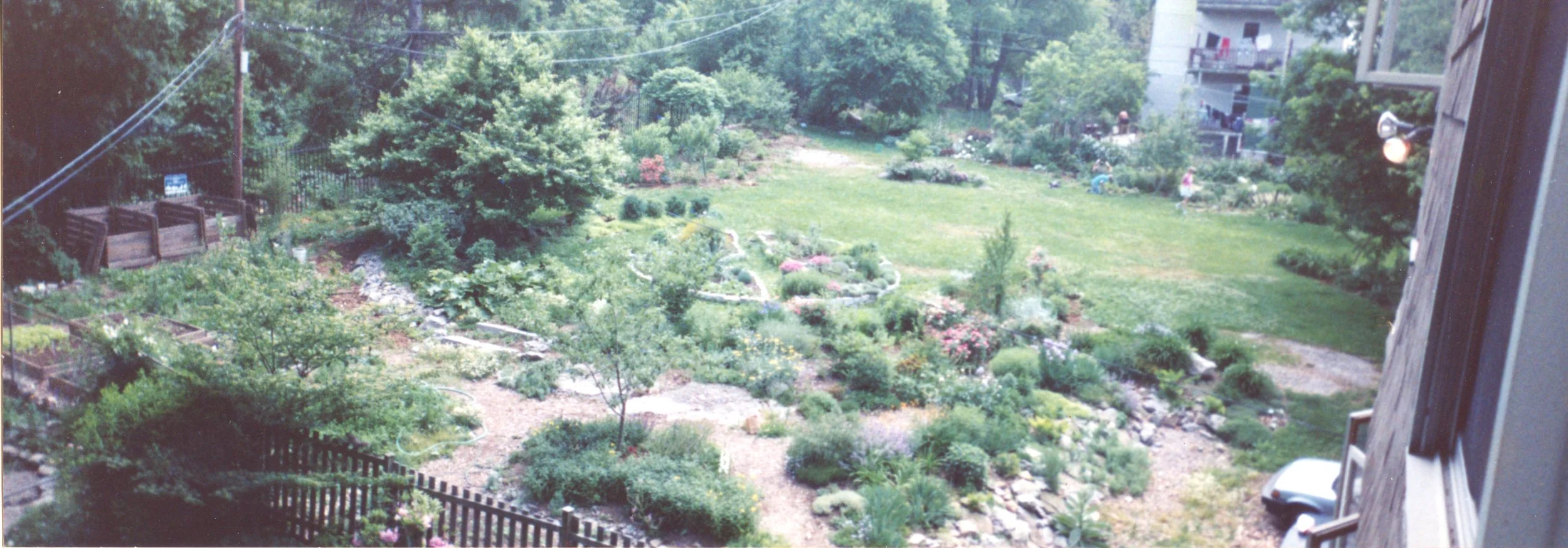
Leland Street Garden, then known as Leland Street Herb Garden as it looked in 1990, the year neighbors finished it.
In that first official growing season, the children who had worked consistently along with the adults to build the Garden were given their own bed, and asked what they would like to plant. “Flowers for our mothers” was the answer. In an oval-shaped bed near the front of the Garden, six or seven children scattered the contents of many envelopes of zinnia, marigold, and sunflower seeds. This Children’s Cutting Garden flourished beautifully, and its creators cut many bouquets – although sometimes they got carried away playing in the garden and didn’t get the cut flowers home to Mom before they wilted. Kids planted this flower garden yearly for several years. It is still a part of the Leland Street Garden, but now the growth of nearby trees has greatly reduced the area suitable for growing annual flowers, and in recent years fewer kids have been involved in the planting, and fewer neighbors cut bouquets to bring inside.
In the second year that children planted their flower garden, a complete destruction of the young plants was narrowly averted by a seemingly miraculous event. About three weeks after the seed planting, I noticed one morning that the tiny seedlings were covered with hungry black aphids. Though this was very disappointing – heartbreaking, really – I thought that by the time we figured out how to kill the aphids, the tiny plants would be gone. “Oh well,” I concluded, “I guess we all have to learn that Nature doesn’t always share our priorities.” The next morning, however, when I walked out to view the destruction, I found not an aphid in sight, and the tiny seedlings were recovering from their trauma. What had happened? Closer inspection revealed two praying mantises licking their chops. I thanked them profusely and had the distinct impression that someone or something – a garden angel maybe? – was overseeing this special place.
In the second official growing season of the Garden (1991), the Massachusetts Horticultural Society divided its prestigious statewide Community Garden of the Year award between the Leland Street Community Garden and another new garden in Fitchburg. This was the first of many awards that our Garden was to receive in the next decades – including two first-place Golden Trowels in Mayor Menino’s annual Garden Contest and two Readers’ Choice Awards in the community garden category from the Jamaica Plain Gazette.
Chapter Four: Fun, Flowers and Food in Our Garden, 1991-2008
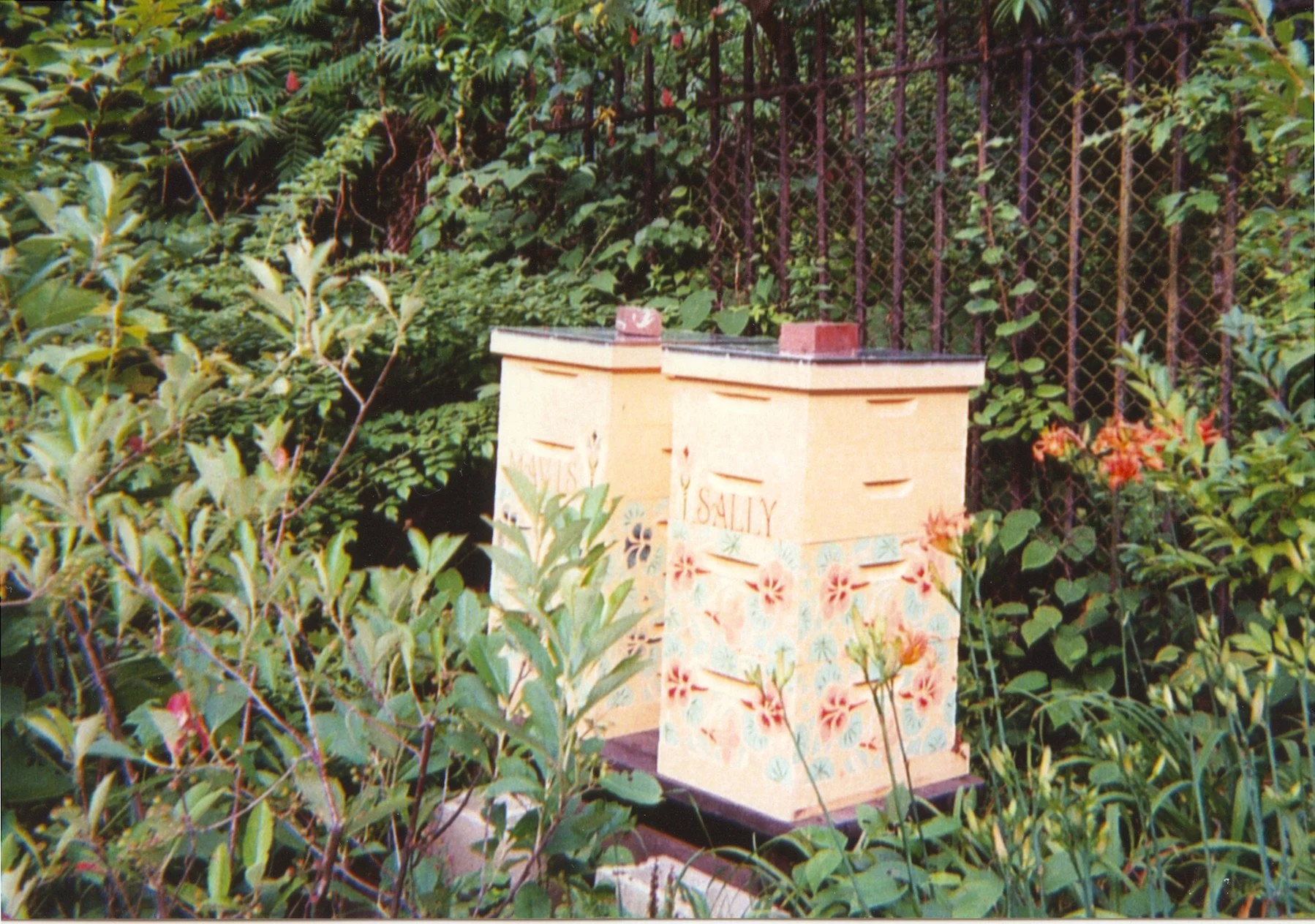
Bee hives painted and kept by beekeepers Sadie Richards and Addie Smith-Reiman, circa 2015
In the nearly two decades since the Leland Street Garden’s official opening, herbs, vegetables, and flowers have flourished during every growing season – and they have been available for everyone in the neighborhood to harvest and enjoy. During every spring, summer, and fall neighbors and friends from other parts of Jamaica Plain have come together on biweekly workdays to plant, water, weed, prune, turn compost and maintain paths. An all-volunteer Steering Committee, made up of anyone willing to come to the monthly meetings, has guided operations. In the mid-nineties, neighborhood beekeeper Mike Graney began keeping hives in the Garden and donating the proceeds from honey sales to support it. In 2003, some relatively new neighbors created a new garden area (called the Peace Garden) and a path on the vacant lot between Leland Street Garden and the Parkman Playground.
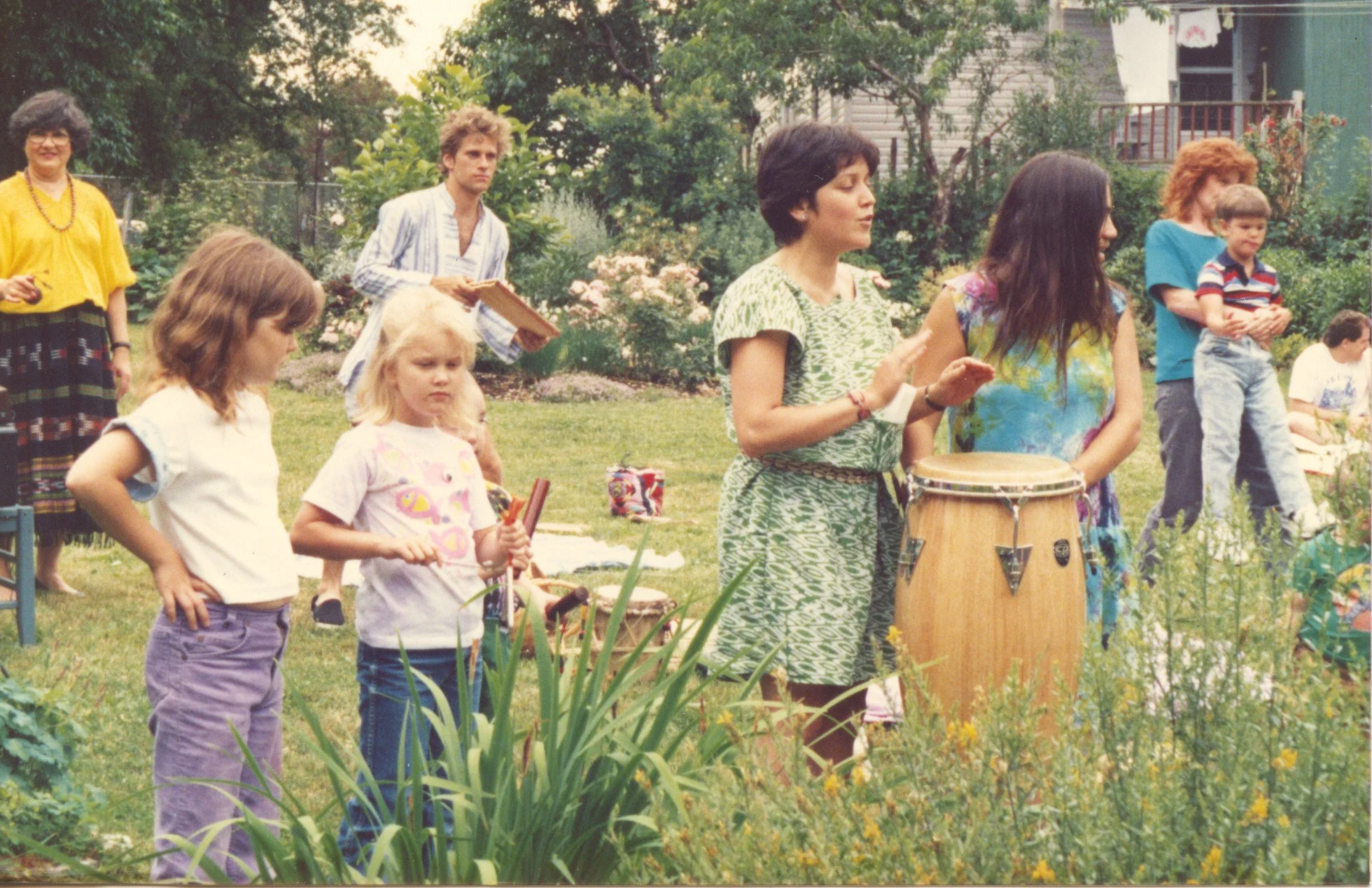
Childrens' music party led by Sue Dario. 1993-1999.
In addition to all the gardening and honey production, the original vision of the Garden as a neighborhood gathering place was realized with many community parties, concerts, picnics and children’s events, as well as yoga and tai chi classes, herb workshops, and lots of games of croquet, badminton, and bocce. Several of the seasonal celebrations in the Garden have become annual events. The last Sunday of August has been Honey Day for 13 or 14 years. Hundreds of visitors have come on Honey Days at Leland Street Garden to buy honey and enjoy refreshments made with garden herbs, mead made from garden honey, live music, and garden tours. One year, thanks to master chef Mike Graney, Honey Day even included a prix fixe dinner at the Dogwood Café featuring Leland Street herbs or honey (or both) in every course. In a very different season, the heartiest of Forest Hills neighbors have celebrated the Winter Solstice, December 21, every year for many years by lighting our Garden with luminarias – votive candles in sand-filled paper bags – creating a truly magical atmosphere. We drink hot cider or mulled wine and sing together to call back the sun. The candles usually stay lit all night.
A third seasonal celebration is fast becoming an annual tradition. For the past three years a Children’s Halloween Party, organized by the neighborhood parents, has filled the Garden with little ghosts, fairies, frogs, princesses, and pumpkins playing games, bobbing for apples and taking turns being blindfolded and trying to break open the candy-filled pumpkin pinata.
I have enjoyed gardening my whole life, ever since I worked with my father in our Victory Garden plot in the 1940s. I can honestly say that gardening with my neighbors in the Leland Street Community Garden has been the most pleasurable of all my gardening experiences. As for the community parties and events in the Garden, I have attended most of them, and I rank them among the most fun memories of my many years. Three Garden events stand out in my memory. The first is the Ninja Turtle Party, conceived entirely by children who helped build the Garden, where all the guests came dressed as their favorite Ninja Turtle. The second outstanding memory is a summer Tea Party, sometimes remembered as the Hat Party because the invitation said “Hats Required, Shoes Optional.” Steering Committee members circulated among the guests with trays of savory and sweet goodies made with herbs and vegetables from the Garden, while another neighbor sat under the apple tree playing classical guitar music. The third event in my “best memory” list is a Treasure Hunt, with hidden poetic clues leading us from one garden plant to another. It was a delightful way to be introduced to the Garden’s many treasures.
Chapter Five: The Garden in Recent Years
During the late 1990s and early 2000s, the neighborhood around the Leland Street Garden changed dramatically. As home values rose sharply, the Forest Hills neighborhood became more prosperous but also increasingly unstable. Turnover among neighbors was rapid as homeowners could sell houses for several times what they had paid, and tenants were forced out by ever-increasing rents and condo conversions. Many people moved into the neighborhood, enjoyed and helped maintain the Garden for a season or two or three, and then moved away. It became difficult for the small all-volunteer Steering Committee to make sure that all the new neighbors even knew of the Garden’s existence, and that their participation was needed and welcomed.
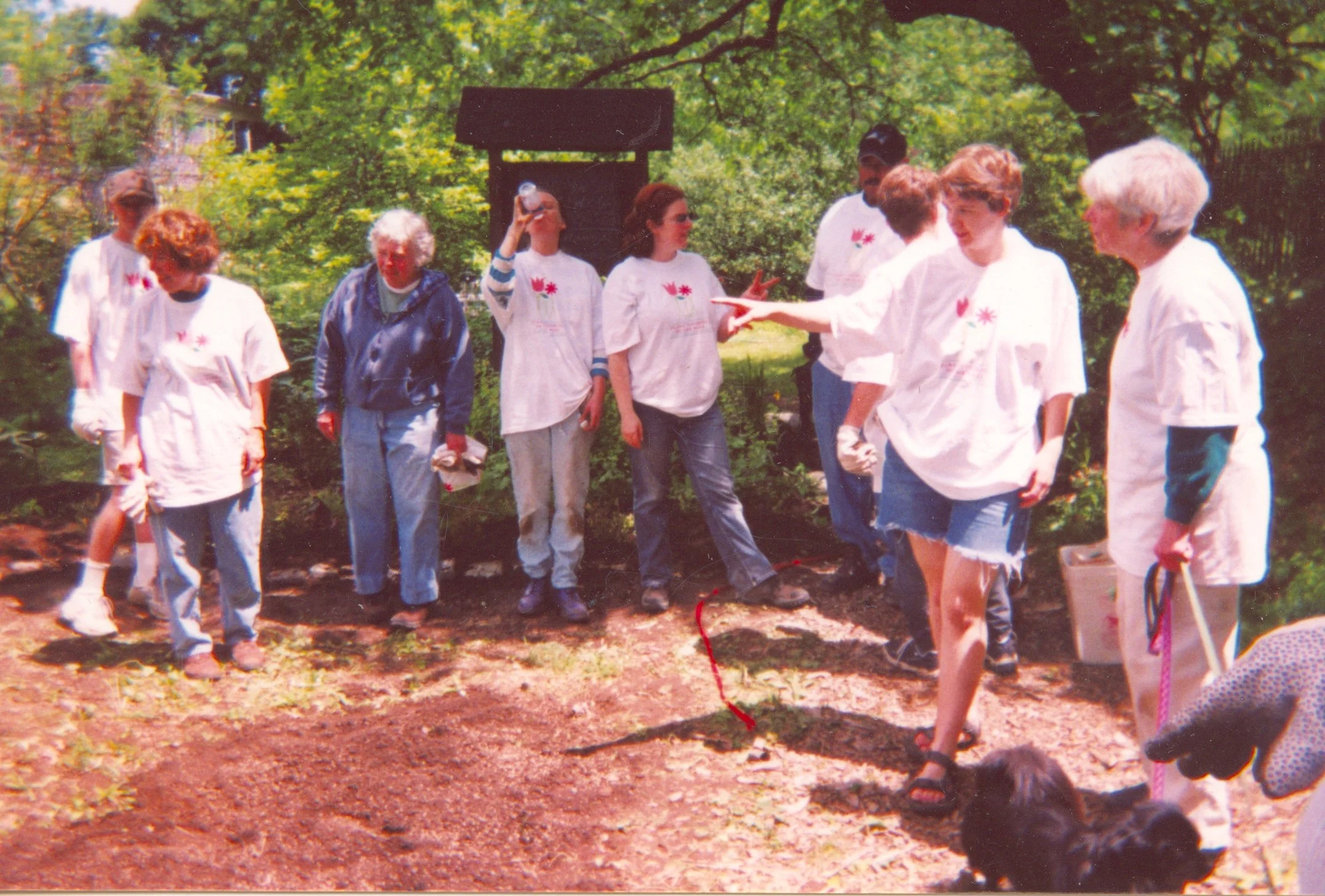
Starting the Peace Garden, 2003
Ironically, the very success of the Leland Street Garden contributed to the soaring real estate values which destabilized the neighborhood. On several occasions I met real estate agents showing the Garden to potential home buyers, using the beauty and peace of this public open space as part of their justification for the inflated asking prices of nearby homes.
As the 2009 growing season approaches, it seems to those of us who have volunteered on the Garden Steering Committee for the past few years, that we need a new vision for our Garden. Trees, shrubs, and weeds – including our old enemy knotweed – have kept growing vigorously in recent years, but the number of neighbors who share a vision of what the Garden means to our community has dwindled. During the past couple of growing seasons, the biweekly workdays to maintain the Garden have often consisted of one or two people, rather than the five or six workers which can make the work so much fun and so empowering. In addition, fewer people have been willing to participate in the monthly Steering Committee meetings to assess and address Garden needs, and fewer neighborhood events have been organized.
Public open space in a city such as Boston is a precious commodity. As the history of the Leland Street Community Garden demonstrates, it can go a long way toward making a neighborhood feel like a community. But unless a lot of us value our public open space enough to maintain and use it, the model cannot be sustained. Now is the time for many of us to work together to ensure the Garden’s joyous history continues through the coming decades.
Thanks to Kathy Griffin for editorial assistance and to Charlie Rosenberg for photographic digitization and correction.
Videos about the Leland Street Gardens:
https://www.youtube.com/watch?v=nrznX3gccRw
https://www.youtube.com/watch?v=Hl9Vd9weL68
https://www.youtube.com/watch?v=gFRfsqSKduo
Please visit Part Two for an oral history done with community members involved in maintaining the Garden from 2008 to 2026: history-of-the-leland-street-cooperative-garden-part-two