Maud Cuney Hare: Trailblazing Musician, Writer, Musicologist and Activist
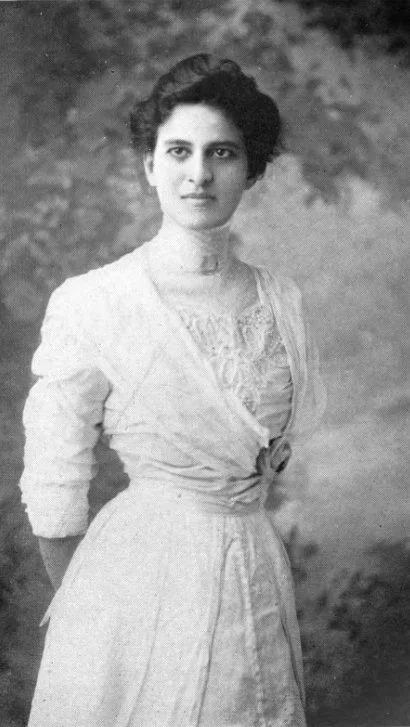
Maud Cuney Hare, image from Wikipedia
Maud Cuney Hare was a multidimensional intellect and virtuoso: pianist-lecturer, composer, playwright, biographer, poet, editor, Black music historian and collector of music. She was also the founder and director of the Allied Arts Center in Boston.[1] She moved to Jamaica Plain in 1904 and lived there for over thirty years. Living in a period of legal segregation, disenfranchisement and lynchings, Maud Cuney Hare stood up to the racism of the time. She both directly confronted segregated practices and used the arts, scholarship and public performance as tools of resistance. In her lifetime, she:
Desegregated student housing at the New England Conservatory
Refused to perform before segregated audiences
Collected, performed and wrote about music originating from the African diaspora, including African American and Creole music
Contributed to Black journals
Founded an arts center to encourage Black artistry.
Fighting Discrimination at the New England Conservatory
The daughter of formerly enslaved people, Maud was born in 1874 to a prominent family in Galveston, Texas. Her father Norris Wright Cuney was a titan of 19th century Texas politics and labor who was widely considered the most influential Black leader in the state during the post- Reconstruction era.[2] Her mother Adelina Dowdy Cuney was a schoolteacher.[3] Her parents had a great interest in music. Norris played the violin and Adelina was a pianist who sang publicly on occasion. They encouraged Maud to move to Boston to study music at the New England Conservatory of Music after she finished high school.
Maud was 16 when she graduated from Galveston’s Central High School in 1890 and arrived in New England. She spent the summer in Newport, Rhode Island, and started at the Conservatory at the end of the summer. She faced problems immediately.
Maud was one of two Black students enrolled in the Conservatory.[4] When White students learned that Maud and Florida L. DesVerney were living in a campus dormitory, some of them tried to have the young women removed. Maud’s father received a letter from the school in October 1890, just weeks after the semester had started, asking him to support Maud living off campus since many of the other Conservatory students in the dorm were “affected by race prejudice.” Norris Cuney responded with an eloquent letter to the school refusing to do so and criticized the school for dishonoring “the noble men and women” abolitionists of Massachusetts. Affectionately praising his daughter, he wrote to her, “I can safely trust my good name in your hands.”
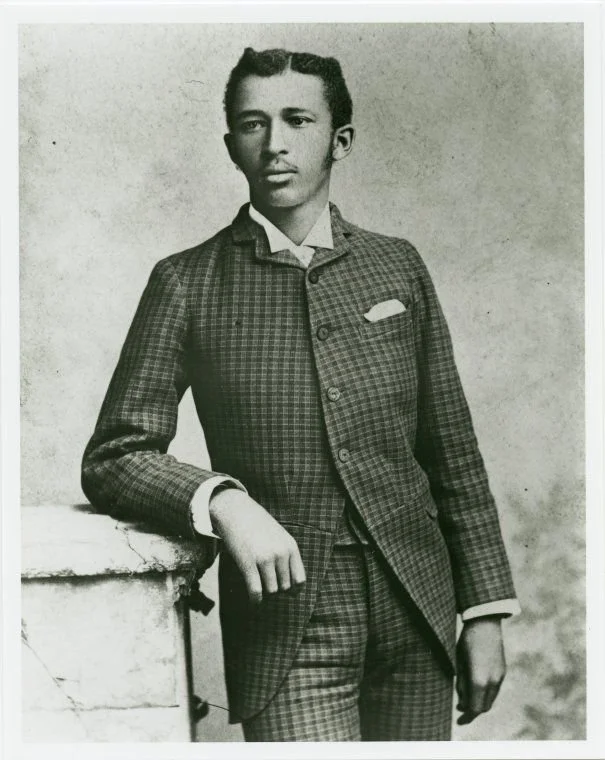
W.E.B Du Bois as a young main. Image from New York Public Library
The incident outraged local civil rights organizations which, along with Black students from Harvard, took up the issue. Eventually the Conservatory reversed its position. Under the strain, DesVerney chose to move off-campus so 16-year-old Maud bore the brunt of the racism alone. Maud wrote years later about how she remained at the Conservatory and was “subjected to many petty indignities, but I insisted on proper treatment.”[5] W.E.B. Du Bois was one of those Harvard students who was impressed by Maud, calling her “the bravest woman” he had ever known. Du Bois described her as “tall, imperious, brunette, with gold-bronze skin, brilliant eyes and coils of Black hair.”[6] He fell deeply in love with her and they were briefly engaged. They remained friends for many years.
Maud completed her studies in piano and music theory at the Conservatory and graduated in 1895. She stayed on at Harvard’s Lowell Institute of Literature after graduation to study English literature. During her student years, she became part of Boston’s vibrant Black community, joining the Charles Street Circle, aka the West End Set, that met at the home of Josephine St. Pierre Ruffin.[7] Years later, Maud would encounter Ruffin again through their participation in Boston’s League of Women for Community Service, founded by Maria Baldwin in 1918.[8][9]
The Texas and Chicago Years
Maud Cuney returned to Texas in 1897 and took a job as music director at the Texas Deaf, Dumb and Blind Institute for Colored Youths in Austin. She also performed music publicly, opposing racial prejudice when the management of the Austin Opera House demanded that the audience be segregated. She and her fellow pianist Emil Ludwig cancelled the engagement and instead performed at the Institute where audiences of all races could sit together.[5]
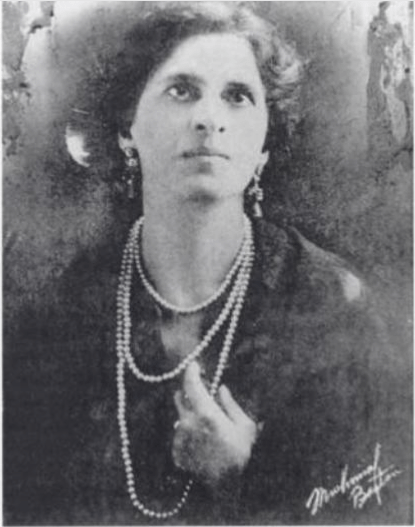
Maud Cuney Hare, c. 1910. Texas State Historical Association
In 1898, 24-year-old Maud met J. Frank McKinley in Austin. McKinley was 20 years her senior and, like Maud, of mixed race. He persuaded her to move to Chicago, where in 1900 they had a baby girl, Vera, whose birth certificate identified her as Spanish-American.[5] Maud’s and Frank’s relationship began to disintegrate and they divorced in 1902. By law, Frank took custody of Vera.
After her marriage broke up and she lost custody of her child, a heartbroken Maud returned to Texas where she taught music at Prairie View State Normal Industrial College, the first state- supported college in Texas for Black people.[10] In 1906, Maud gained access to her daughter during the summer months.[7]
Sadly, Vera died in 1908 at age 8. Ten years later, in 1918, Maud honored her daughter in an anthology she edited called The Message of the Trees: An Anthology of Leaves and Branches. Maud featured “To My Little Daughter Vera, 1900-1908” by her friend Ethelwyn Wetherald as the first poem of the book.
The Return to Boston
Maud moved back to Boston and married William Parker Hare on August 10, 1904. He came from a well-established family in Boston. The Hares bought a house at 43 Sheridan Street in Jamaica Plain and Maud lived primarily there until her death in 1936.
Maud Cuney Hare became a prominent figure in Boston’s Black intellectual and artistic community. She was also active in social movements, using her skills and interests in the arts to promote Black talent and history. In 1907, she was one of the first women to join the Niagara Movement which was founded in 1905 by W.E.B. Du Bois. The Niagara Movement was a civil rights organization that advocated for immediate and full political, economic, and civil rights for Black people and was the forerunner to the National Association of Colored People (NAACP).[11]
When the NAACP was established in 1909, W.E.B. Du Bois served as director of publications and founded The Crisis magazine. Maud wrote a regular column for the magazine on music and art, contributing to the magazine for the next 10 years. Her last known article in The Crisis was “Ethiopean Art” published in the October 1921 issue (Vol. 22, No. 6).[12] She also contributed articles on Black music and arts to the Christian Science Monitor, Musical Quarterly, Musical Observer and Musical America.[5]
Racial Climate in the Early 1900s: Jim Crow and Lynchings
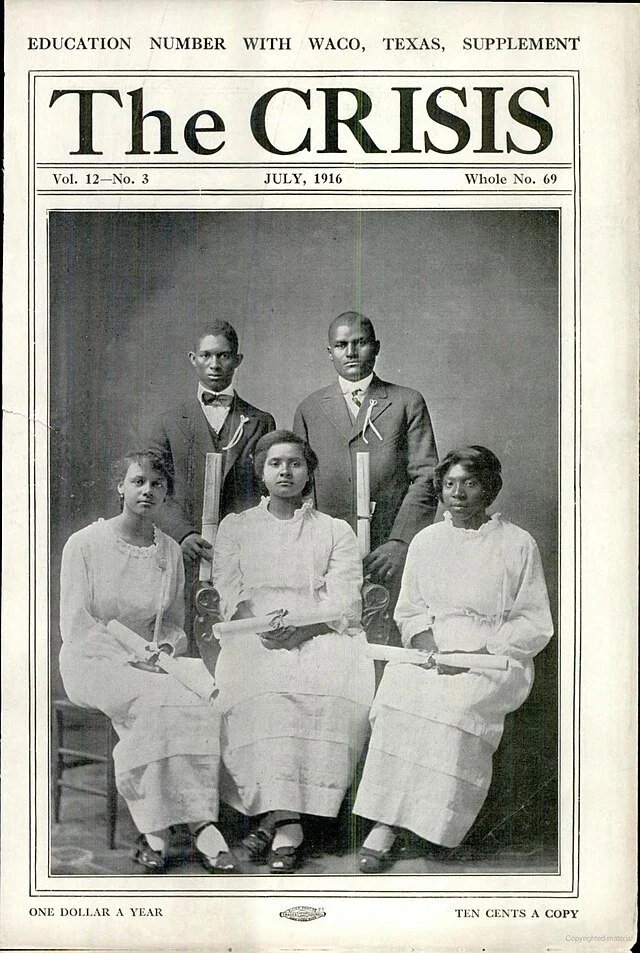
In 1916, the NAACP’s The Crisis magazine published a photo essay on “The Waco Horror” covering the lynching of Jesse Washington, Wikimedia Commons
From the end of Reconstruction in the late 1870s through the early 20th century, state and local governments primarily in the American South passed Jim Crow laws that enforced racial segregation and disenfranchisement in nearly every aspect of daily life for Black citizens. These laws mandated separate and unequal facilities for Black people in schools, hospitals, restaurants, and public transportation. Black citizens were disenfranchised through poll taxes, literacy tests, local ordinances, intimidation and terrorism.[13]
Often, these discriminatory laws were underpinned by lynchings – the public killing of individuals without due process. These illegal executions were frequently carried out by lawless mobs. Particularly in the South in the 19th and 20th centuries, White people used lynchings to terrorize and control Black communities.[14] Many Black people were murdered for violating segregation “norms” or asserting their rights. Between 1877 and about 1950, nearly 4,000 Black people were lynched in the South alone.[15]
The NAACP led a courageous battle against lynching. In the July 1916 issue of The Crisis, editor Du Bois published a photo essay called “The Waco Horror” that featured brutal images of the lynching of Jesse Washington.[16] The Crisis circulation grew by 50,000 over the next two years, and raised $20,000 toward an anti-lynching campaign. In 1919, the NAACP published “Thirty Years of Lynching in the United States, 1889-1919” to promote awareness of the scope of lynching. The NAACP continued this fight through the 1950s.[17]
Racism in Jamaica Plain
In Jamaica Plain, anti-Black attitudes surrounded Maud. One piece of evidence acquired by the Jamaica Plain Historical Society is a program for the “Minstrel Frolic” held in April 1913. The JP Council of the Knights of Columbus sponsored the event, and the program listed 28 Jamaica Plain and local sponsors. The group rented New England Conservatory’s Jordan Hall for the show, the same school that had tried to ban Maud from its dormitory in 23 years earlier. [18]
This was not the first or only minstrel show originating in Jamaica Plain. The Jamaica Club which was originally located on St. John and later moved to the corner of Green and Rockview Streets regularly sponsored minstrel events from the 1880s through the second decade of the 1900s at Eliot Hall.[19] In October 1901, the young men of Jamaica Plain’s Church and Parish of the Blessed Sacrament performed a minstrel show, followed the next month by a performance by the young women. At the end of the same year, The Knights of Columbus held its minstrel show at Curtis Hall. [20]
Minstrel shows were musical stage performances, popular from the 1830s to the early 1900s. White performers, their faces blackened with burnt cork, wore woolly wigs and ragged clothes to ridicule Black people as ignorant, lazy, and joyous simpletons.[21] Blackface performances grew particularly popular between the end of the Civil War and the turn-of-the 20 th century in Northern and Midwestern cities, where regular interaction with Black people was limited. White racial animus grew following Emancipation when antebellum stereotypes collided with actual Black people and their demands for full citizenship including the right to vote. The influence of minstrelsy and racial stereotyping on American society cannot be overstated.[22]
Maud Cuney Hare’s work stood in direct contrast, preserving Black humanity at the exact moment minstrelsy was caricaturing it. She was a talented musician who performed classical concerts as well as a musicologist who in later years researched, wrote and published the ground- breaking book Negro Musicians and Their Music.
Early Musicologist of African and African-American Music
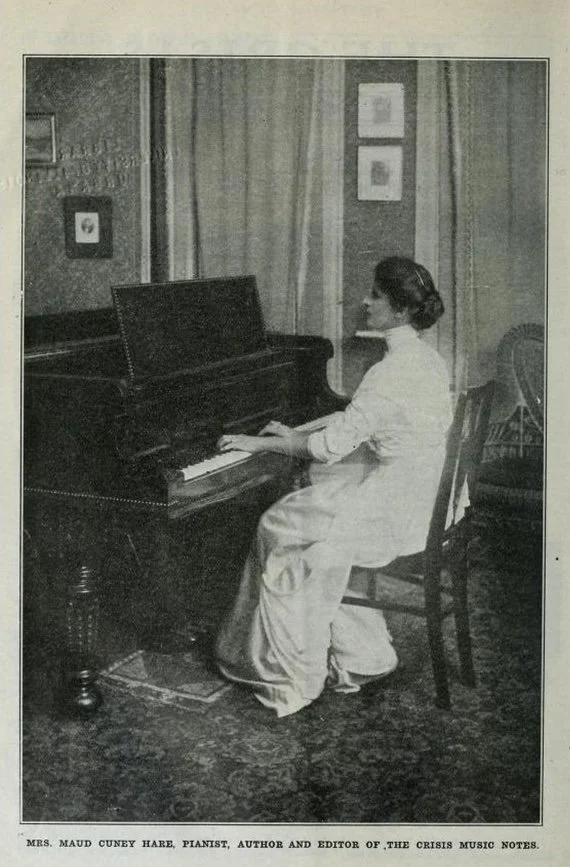
The Crisis, March 1914 from Internet Archive
During the 1910’s, Maud began to travel to search for music and, in the process, met Canadian singer William Howard Richardson, a baritone and vocal teacher. Sharing an interest in music of the African diaspora, they toured together periodically for 20 years. The two presented concerts and lectures across North America as well as collected music from the places they visited: Mexico, the Virgin Islands, Haiti, Puerto Rico and Cuba as well as across the United States. Their concert-lectures proved to be so popular that Maud employed two booking agencies to schedule them a year out.[4]
In 1916, they gave a lecture in Boston on the “Contribution of the Afro-American to the Art of Music.” Later, in 1919, they presented a concert and lecture series at the Boston Public Library, the library’s first-ever performances by Black musicians.
Maud also presented concerts with other musicians across the city. In 1917, she and Richardson teamed up with Black tenor Roland W. Hayes, who would later become widely acclaimed. They offered a musical program at Boston’s Old South Meetinghouse featuring Maud’s piano selections and solos by the others.[7]
As a pioneer ethnomusicologist, Maud Cuney Hare was especially interested in African and Creole music and spent time in New Orleans focusing on Creole music. She gathered music from local people and compiled the material into a book that she published as Six Creole Folk-Songs in 1921. She was expert in the field.[23] Hare and Richardson presented a concert-lecture of African American and Creole music at Boston’s Steinert Hall in 1920.[7]
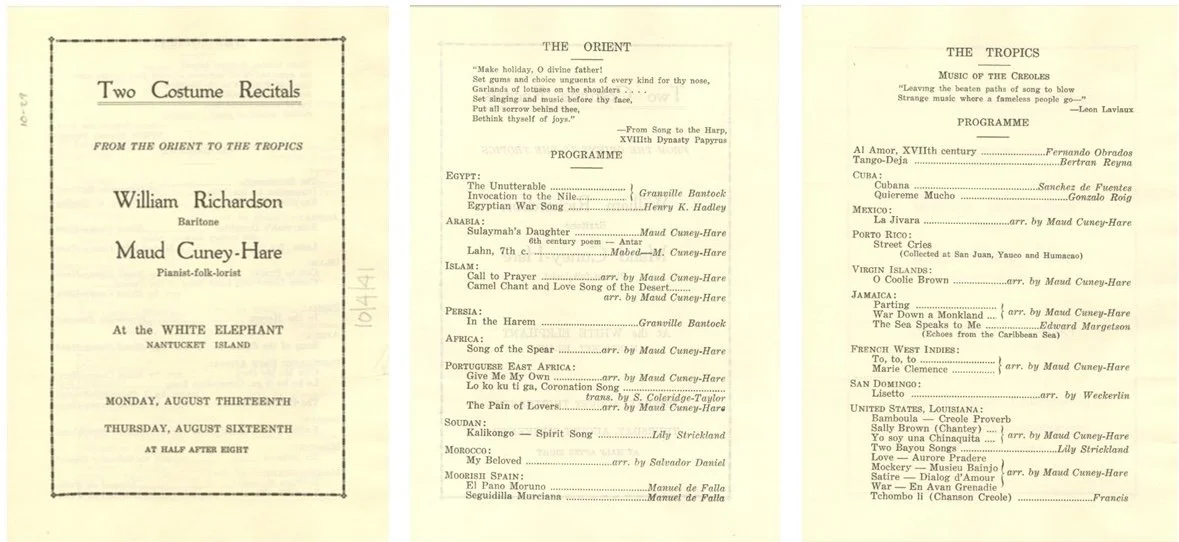
For nearly 20 years, Hare and Richardson performed concerts across the United States such as this one given in 1928 in Nantucket, MA, UMass Amherst Credo
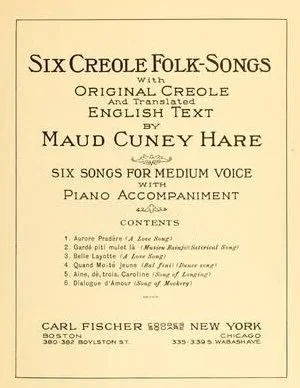
Six Creole Folk Songs by Maud Cuney Hare, Internet Archive Open Library
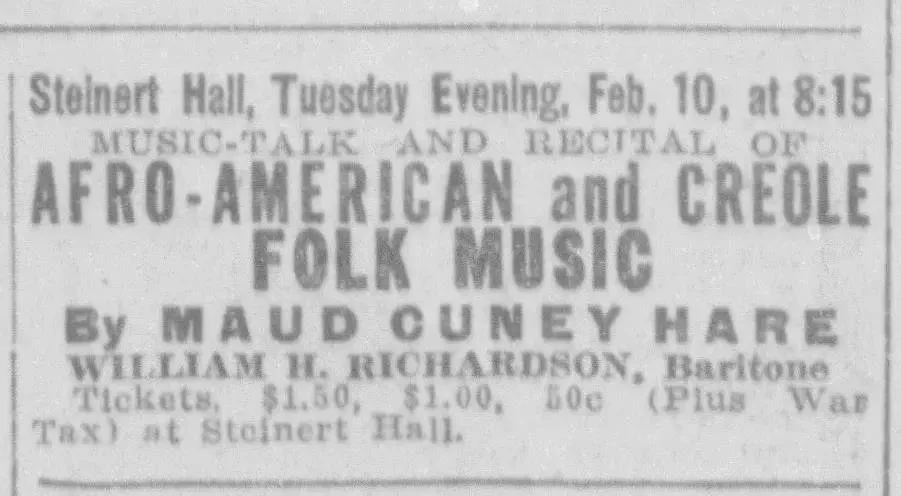
Concert and lecture advertisement, 1920, Boston Globe, February 8, 1920
Developing Black Arts in Boston
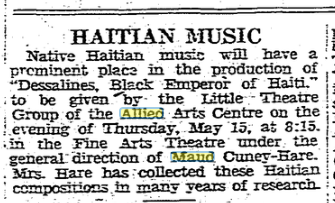
Announcement of “Dessalines, Black Emperor of Haiti,” Boston Herald May 4, 1931
In 1927, Maud Cuney Hare founded the Allied Arts Centre, which emerged from her 1925 Musical Arts Studio on Huntington Avenue. In addition to providing funding and serving as a manager, she performed and lectured there. The Centre hosted concerts, lectures and classes in art, music and drama before closing in 1930. Although open to all, its focus was to develop and support young Black performers, composers and playwrights.[24] Both known and up-and- coming writers produced original plays before filled houses of integrated audiences.
Maud’s own 1928 play “Antar of Araby” about the fifth-century Black Arabian poet-warrior Antar ibn Shaddad was performed to positive response, with newspapers of the day praising the production. Many of the talented people who participated in the Centre would go on to develop national reputations as artists in their fields.
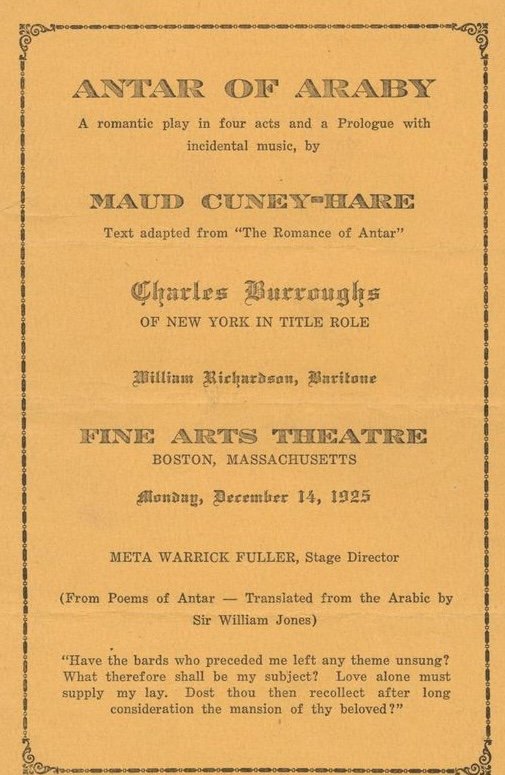
Antar of Araby Program, Northwestern University online archive
Milestone Book: Negro Musicians and Their Music
Throughout her years of research and collecting music, Maud Cuney Hare was working toward a book on the history of African music, tracing it from its origins and documenting the African influences on American music from spirituals to jazz. The 439-page book included biographies of contemporary musicians as well as early Black pioneers of American and international renown. Maud completed her book in the 1920s but had difficulty finding a publisher for the work titled Negro Musicians and Their Music.[25] The only other volume that had ever been published on Black music was the 1878 Music and Some Highly Musical People by James Monroe Trotter.[4]
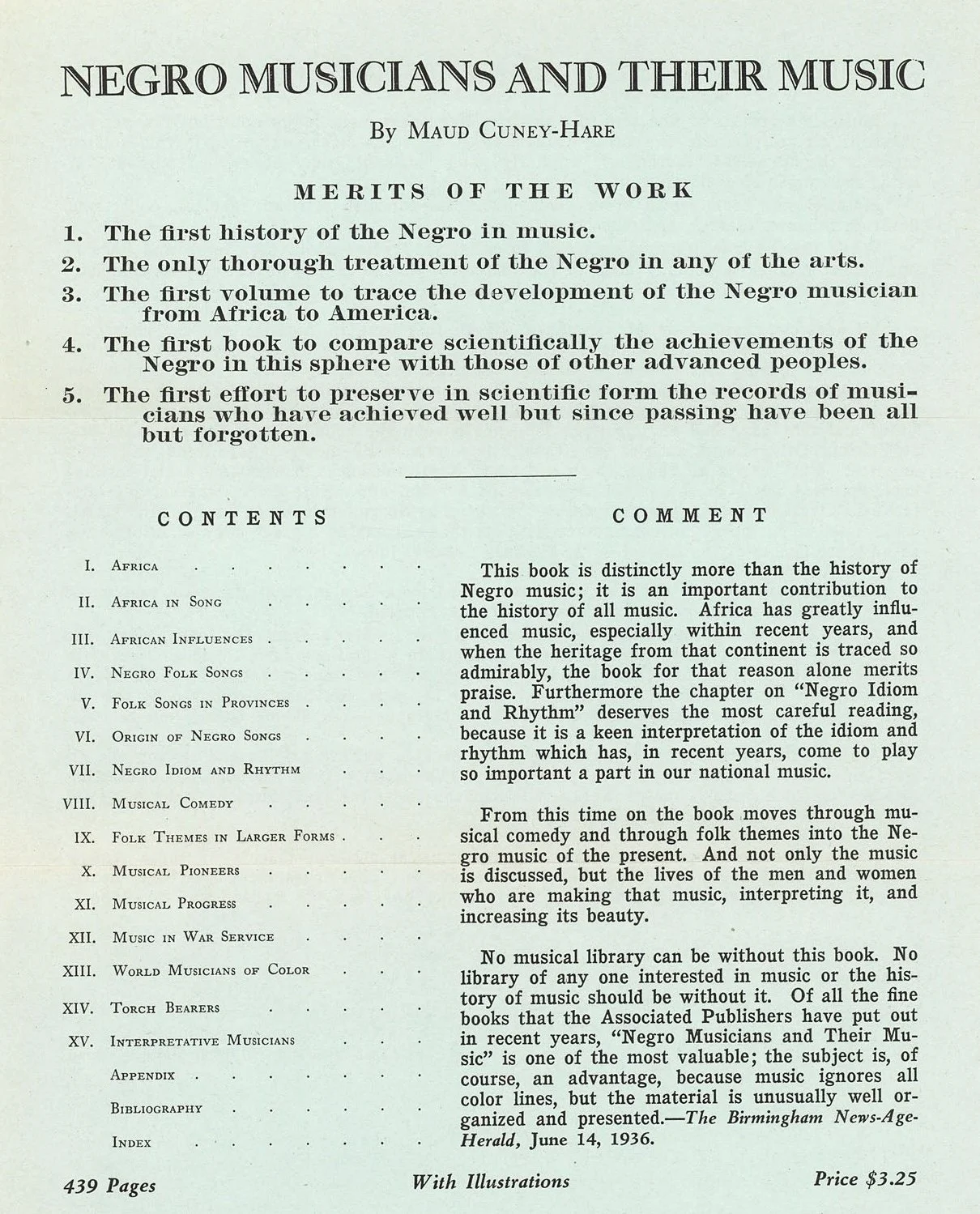
Diagnosed with cancer, Maud was in poor health for some time. She died in 1936 at the age of 61 shortly before her book was finally published. She was buried in Galveston beside her parents.
***
The authors gratefully acknowledge Jené Watson for her generous support and contribution to our volunteer research efforts through her “Tea for the Soul: A Toast to Maud Cuney Hare, Pioneering Member of the League of Women for Community Service” presentation on February 22, 2026.
This article was written by volunteer researchers associated with the Hidden Jamaica Plain project and is based on materials available at the time of publication (March 2026). Information may change as research continues and more materials are uncovered.
Note on the Authors: Hidden Jamaica Plain
Please see this other article on Maud Cuney Hare for more information:https://www.jphs.org/people/2005/4/19/african-american-women-in-jamaica-plain-history.html
End Notes
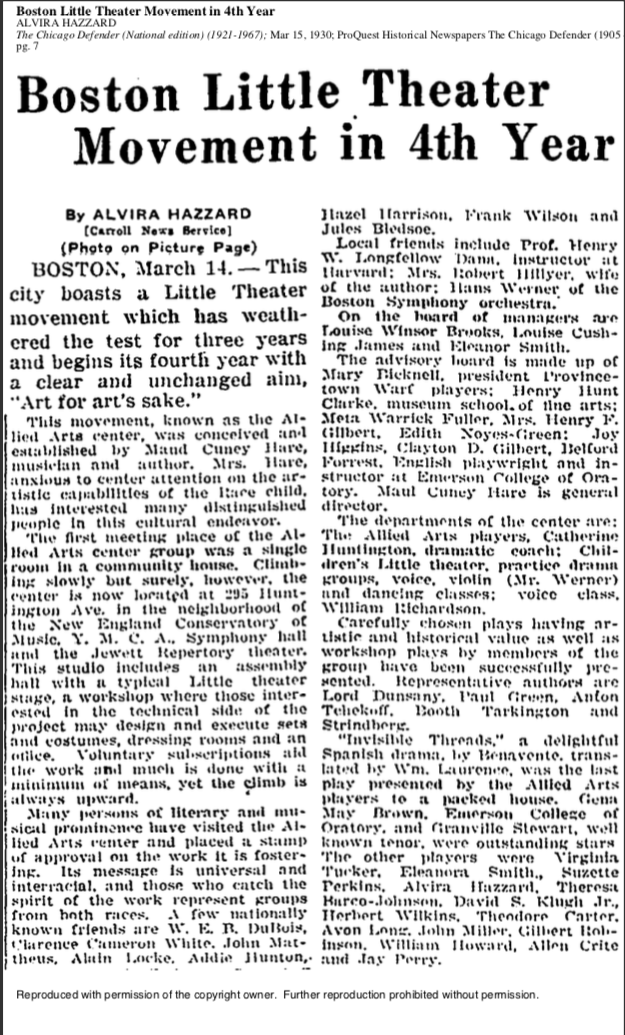
Chicago Defender, March 15, 1930, ProQuest Historical Newspapers
1 “Maud Cuney Hare” by Elizabeth Quinlan, Jamaica Plain Gazette, August 28, 1992
2 https://en.wikipedia.org/wiki/Norris_Wright_Cuney
3 https://en.wikipedia.org/wiki/Maud_Cuney_Hare
4 Rachel M. Washington was the first Black student to graduate from the New England Conservatory in 1876. Her parents were the prominent abolitionists George and Rachel Washington. https://necmusic.edu/about/news/archives-celebration-necs-african-american-legacy/
https://www.beaconhillscholars.org/about/tributes-and-profiles [See Christle Rawlins-Jackson entry]
5 https://songofthelarkblog.com/2018/05/30/maud-cuney-hare/
6 Autobiography of W.E.B. Du Bois: A Soliloquy on Viewing My Life from the Last Decade of Its First Century by W. E. B. Du Bois and Herbert Aptheker | Jan 1, 1968
7 Douglas Hales, A Southern Family in White & Black: The Cuneys of Texas, Texas A&M University Press, 2003
8“Maud Cuney-Hare: Lifting Race through the Arts”by Anthony W. Neal, Bay State Banner, Nov. 7, 2012 https://baystatebanner.com/2012/11/07/maud-cuney-hare-lifting-the-race-through-the-arts/
9 League of Women for Community Service https://www.lwcsboston.org/about/the-leagues-history
Maria Baldwin's World by Kathleen Weiler, pages 163-4 and 167 ff.
10 https://www.pvamu.edu/about_pvamu/college-history/
11 https://www.britannica.com/topic/Niagara-Movement
12 https://www.marxists.org/history/usa/workers/civil-rights/crisis/1000-crisis-v22n06-w132.pdf
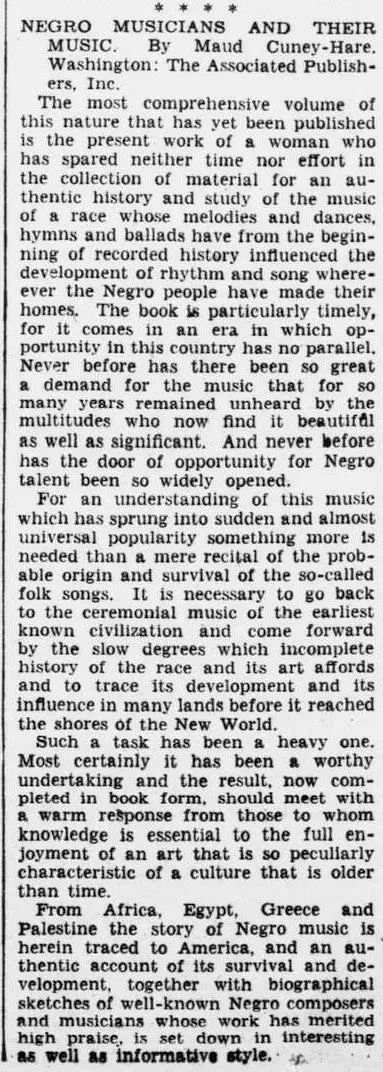
Review of “Negro Musicians and Their Music,” Washington Evening Star, June 10, 1936
https://www.pbs.org/wgbh/americanexperience/features/freedom-riders-jim-crow-laws/
14 https://naacp.org/find-resources/history-explained/history-lynching-america
15 Lynching in America: Confronting the Legacy of Racial Terror, Equal Justice Initiative Report, 2017
https://eji.org/reports/lynching-in-america/
16 https://en.wikipedia.org/wiki/Lynching_of_Jesse_Washington
17 NAACP History of Lynching in American https://naacp.org/find-resources/history-explained/history-lynching-america
18 “Amateur Minstrels,” Boston Globe, April 22, 1887
20 “A Minstrel Show in the Woodpile,” https://rememberjamaicaplain.blogspot.com/search?q=minstrel
22 https://nmaahc.si.edu/explore/stories/Blackface-birth-american-stereotype
23 https://www.tshaonline.org/handbook/entries/cuney-hare-maud
24 Wintz, Cary; Finkelman, Paul (2004). Encyclopedia of the Harlem Renaissance. New York: Routledge. pp. 281– 282.
25 Negro Musicians and Their Music is published in its entirety at: https://digital.library.upenn.edu/women/cuney-hare/musicians/musicians.html