Black Presence at First Church in Jamaica Plain, 1769 – 1837
Mimi - there needs to be some sort of opening/introduction here about what this article is about please…
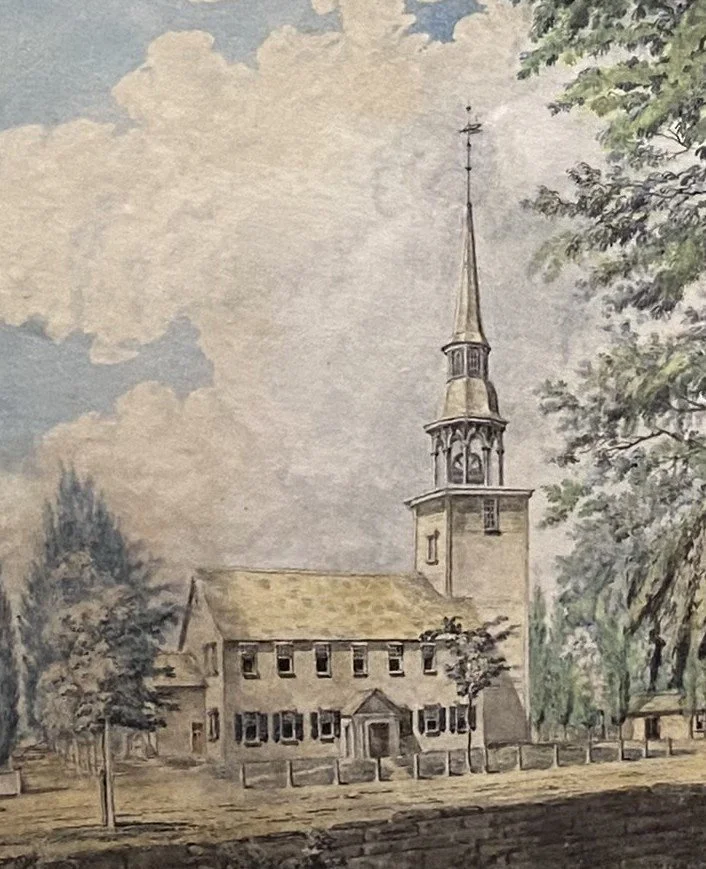
The first building of First Church of Jamaica Plain located on today’s Centre and Eliot Streets, constructed 1769. Painting by Dobbins, courtesy First Church.
Segregated Pews for Black Attendees in the 1700s and Early 1800s
“ … and in the course of a year the house was completed, with thirty-four square pews, and three long seats for the poor on each side the broad aisle next to the pulpit on the ground floor. There were five narrow long pews [for the colored people, several of them slaves] in the front gallery against the wall, and long seats for the singers below.”[1][2]
This description of the 1769 seating arrangements at Jamaica Plain’s first church was written by Thomas Gray in 1842, but the information about five pews in the front gallery being used “[for the colored people, several of them slaves]” was added by Harriet Manning Whitcomb in 1897 as part of the publication, “Annals and Reminiscences of Jamaica Plain.” Why did she add this information?
Harriet Manning Whitcomb, born in 1839, lived in the Jamaica Plain area until her death at the age of 102.[3] The Manning family resided in the area for generations, and used her connections to the Jamaica Plain community to collect oral histories from a number of older residents. This is likely the source of her information on separate seating for Black attendees at the church, since none of the written works she cited in her research mention these dedicated pews. So, the inclusion of “[for the colored people, several of them slaves]” is the product of White community’s local memory. What did those JP families remember, omit or soften?
Why Were Black People Sitting in First Church’s Five Pews in the 1700s?
In the 1770s, slavery was still common in Massachusetts. English colonists enslaved Indigenous people and the first documented ship, Desire, brought enslaved Africans to Boston in 1638. Massachusetts was the first colony to legalize slavery in 1641.[4] It was not until 1783 that court cases of freedom-seeking enslaved Africans paved the way to emancipation and, even then, not all enslaved people were freed.[5]
Research by Hidden Jamaica Plain volunteers uncovered at least 28 people who were enslaved in JP in the 1700s.[6] At that time, Jamaica Plain was part of Roxbury, and First Church served as the only church in Jamaica Plain from its first worship service on December 31, 1769 to 1839 when St. John’s Episcopal congregation was formed and 1842 when the First Baptist Church’s first building was erected. It is highly possible that enslavers required the people they owned to attend First Church during that period.
First Church, located today near the Monument on Centre Street, was then known as the Third Parish of Roxbury because Jamaica Plain was at that time part of Roxbury. The church was founded by Jamaica Plain residents who both enslaved people and/or derived their wealth from their relationships to the slave economy in the North and the South. The church benefitted from its members’ slavery-based wealth in the 1700s and well into the 1800s. Founders Eleazer Weld and John Morey, who gifted a clock that still exists today in the church, were enslavers. Early member and enslaver Sir William Pepperrell presented a Bible to First Church for the use of the pulpit in 1772.[7] Other founders such as Benjamin Pemberton, who provided the money for the first church building, and Nathaniel Brewer came from slave-owning families and owed part of their wealth to enslaved people’s labor as did later members such as John Hancock who provided the first church bell [7], David Stoddard Greenough and Benjamin Bussey.[8]
Many churches in 18th century Massachusetts created separate seating for enslaved people, revealing the separate status they occupied in the community. The balconies of colonial-era churches such as First Church of Roxbury[9], Old North Church[10] and Old South Church[11] were often used for poor, indentured, and enslaved people, and sometimes children. If Whitcomb’s information is correct, then the five pews at Jamaica Plain’s First Church used by Black attendees may have been separate from the seats set aside for the town’s White poor on the main floor.
Were Black and Indigenous People Who Attended Considered Church Members?
In colonial Massachusetts churches, attendance and membership were distinct statuses. Full church membership required a public profession of faith and acceptance by the congregation – a process that was rarely equally available to Black or Indigenous attendees.
Black and Indigenous people participated in predominantly White churches through baptism, public worship, singing, classes, and other shared religious activities.[12] However, this participation did not mean equal standing. Though Black Bostonians, both free and enslaved, attended White churches prior to the 1800s, they often faced discrimination.
Enslaved and free Black residents were often expected or compelled to attend services. Some churches required Black worshippers to sit in the “Negro Pew,” or in the least desirable galleries, and they could not hold leadership positions in the church.[13] Some were baptized and received into limited membership, but without the voting rights or standing enjoyed by White members.
The Gap Between Legal Obligation and Belonging
This distinction matters. Free Black and Indigenous residents could be legally required to financially support colonial churches – through wealth and head taxes – while being denied the full, equal membership. Participation was compelled; belonging was withheld.[14]
By 1638, the Massachusetts Bay Colony legally required residents to pay taxes to support local ministers, even if they did not attend or belong to the church.15] For over 200 years of the Puritan “standing order,” every citizen was legally required to pay municipal taxes to support the local church, regardless of their personal faith.[16]
This mandatory, community-wide tax support for churches in Boston officially ended in 1833 when Massachusetts formally disestablished the state religion with the passage of the 11th Amendment to the Massachusetts Constitution.[17]
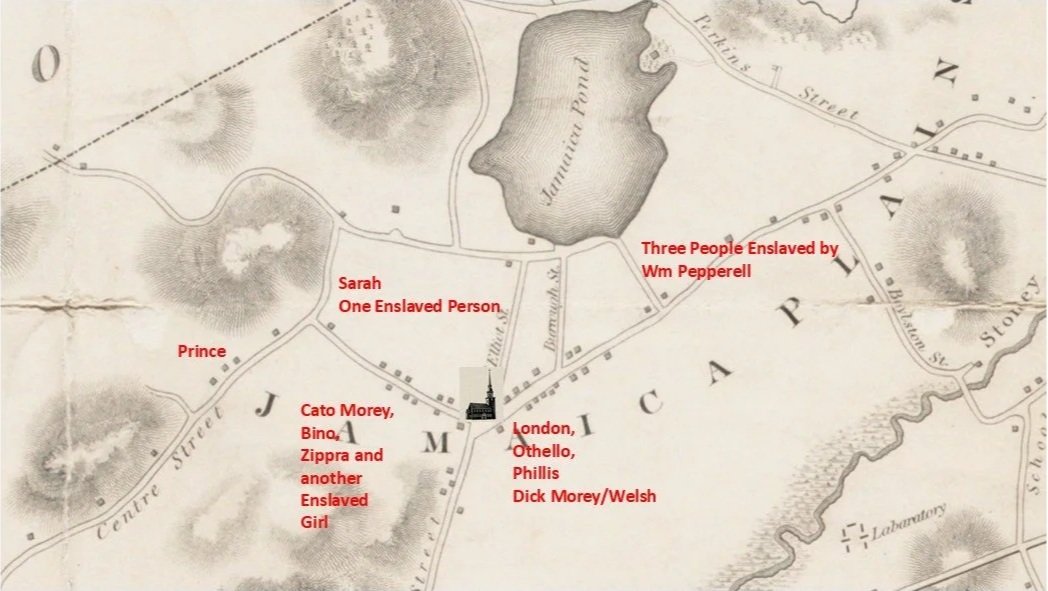
Enslaved People in late 1700s/early 1800s who might have attended First Church in Jamaica Plain, 1832 Map of Roxbury, Leventhal Map Cente
This history suggests that Black landowners in JP such as Peter Bridgham and his descendants (see “Free Black People” below) were required to pay taxes to support First Church, probably starting from 1774 when the deed for Peter’s Centre Street land was finalized until 1833 when the law was abolished.
Possible Black Attendees at First Church in Jamaica Plain
Any Black person living in Jamaica Plain at this time, whether free or enslaved, may have attended the area’s only church and sat in these pews. Here is a compilation of what we know so far about these people and their lives. For more information, follow the links to other articles by Hidden Jamaica Plain. It is not a definitive listing of Black attendees.
Prince
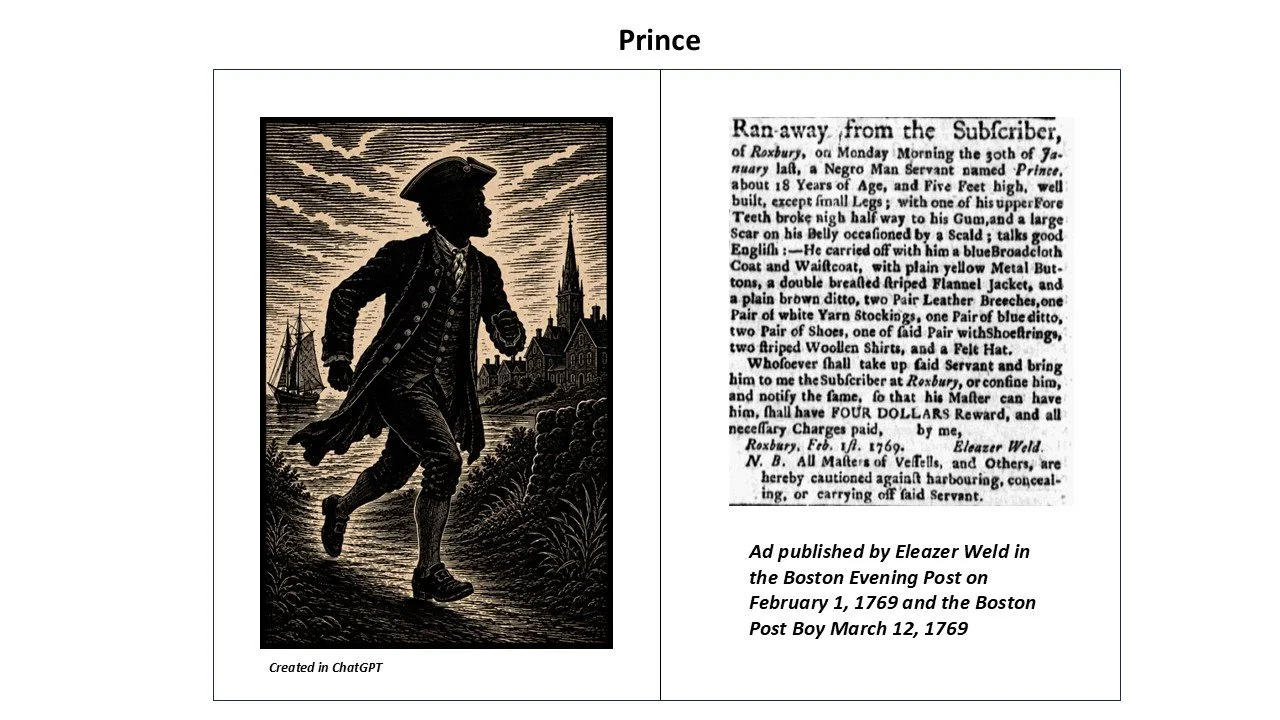
We don’t know the exact identity of the “Servant for Life” (a euphemism for an enslaved person) listed for Eleazer Weld in 1771 tax record, but we do know something about at least one person Weld enslaved in this era. In 1769, two Boston papers ran ads on three different dates in both February and March for “a Negro Man Servant named Prince, about 18 Years of Age” signed by Eleazer Weld.[18]
Prince is described as five feet tall, and well built, except for small legs. One of his upper front teeth was broken. He “talks good English.” Weld must have hoped that these details would enable White people to recognize and return Prince to him. A possible insight into Prince’s life as an enslaved person might be gleaned from the description of “a large Scar on his Belly occasioned by a Scald.” Similarly, one of Prince’s front teeth was broken “nigh halfway to his Gum.” How did those events occur and what, if any, attention did he receive for injuries that were likely painful?
Given that the ad was run three times over a two-month period, it is possible that Prince’s escape succeeded.
Prince’s enslaver Eleazer Weld (1736-1800) was a founder of First Church in Jamaica Plain who enslaved and indentured people, both African and White, for at least 28 years. He was known as a patriot who fought in the Revolutionary War and later served as Justice of the Peace and Selectman of Roxbury, which included Jamaica Plain.
Cato Morey
In 1771, First Church founder John Morey (1738-1800) inherited his father John Morey’s (1687-1771) Jamaica Plain property, including humans. The estate inventory listed four enslaved people, including Cato, Bino, Zippra and an unnamed 11-year-old girl.[19]
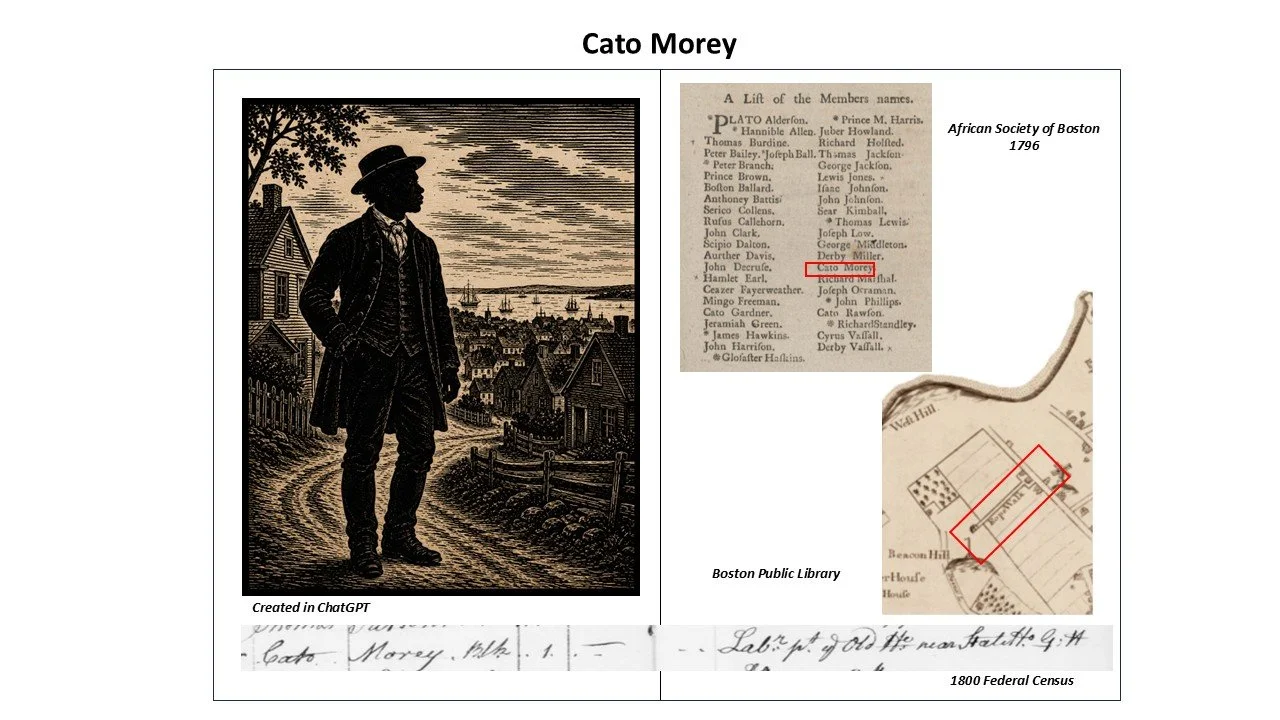
Cato Morey was listed as about 12 years old. Based on the inventory and his death record, Cato would have been born some time between 1756 and 1759. He was valued at £32 in the estate inventory, the highest amount for all of the children the Moreys enslaved. It is likely that Cato worked hard on the Morey farm, planting, tending and harvesting produce and taking care of the livestock.
Hidden Jamaica Plain believes Cato gained his freedom at some point between 1771 and 1796 because a free man named Cato Morey was one of the founding members of the African Society of Boston in 1796.[20] The African Society was a mutual aid group formed by free Africans to promote the social, political and economic advancement of African citizens. They pooled dues and lecture proceeds to pay for education, mutual aid and civil rights of Black individuals in Boston. They also published lectures on the history of enslavement in the Americas.
Cato lived in the Black community on the north slope of Beacon Hill for the last part of his life. In the 1800 federal census, he was listed as “Cato Morey, Black, Laborer” and shown living in “Part of old house near State House” on a street listed at top of page as “Head of Rope Walk” (today near Beacon Hill’s Ridgeway Lane).[21]
Cato also had ties to King’s Chapel. His death is listed in King’s Chapel records as “Died April 1, 1804, Cato Morey, Blackman, 48 years.”[22][23]
Bino/Binah
Bino, also known as Binah, was born around 1764 and lived and worked on John Morey’s Jamaica Plain farm. Seven-year-old Bino was valued in the 1771 estate inventory at 16.0.0£. In 1780, at age 16, Bino/Binah gave birth to a son named Dick (see Dick Morey Welsh below). Presumably, both Bino and Dick lived in the John Morey (son’s) home in Jamaica Plain from 1771 until 1783 when he put his farm up for sale to move to Middleborough. It is likely that Bino performed very labor-intensive tasks on the farm and/or in the Morey household. She may have cleaned, hauled water, cooked meals and done laundry over wood fires, spun, wove and made clothing for the family and the people Morey enslaved. Probably little Dick was even pressed into service as soon as he was old enough to understand instructions.
We know of “Binah” (likely the same Bino since early American spelling varied widely) and Dick through a 1785 Bill of Sale transferring 5-year-old Dick from John Morey to his neighbor David Stoddard Greenough until Dick reached the age of 21. Binah’s fate is unknown. Possibly she accompanied the Moreys to Middleborough in 1783, but Hidden Jamaica Plain has been unable to locate her in Middleborough. Another possibility is that Binah sought her freedom after the 1781 and 1783 court cases by freedom-seeking enslaved Africans Elizabeth Freeman and Quock Walker paved the way end slavery in Massachusetts. In any event, Binah’s young son was torn from her when she was 21 years old.
Zippra
Zippra was a young enslaved woman who lived in Jamaica Plain in the 18th century. She was listed in the estate inventory of John Morey's father in 1771 where she was noted to be an “inferm garl.” It is likely her infirmity, probably a physical disability, meant that Morey valued her at 6.0.0£, far less than he valued the other people he enslaved.
An 11-Year-Old Girl, Name Once Known
In 1771, another girl lived in Jamaica Plain with the Moreys. She must have been a valuable member of the Morey household because she was valued at 26.13.4£ in John Morey’s father’s estate inventory. She was not listed by name but we honor her with the knowledge that at one time she was known by a name and that Cato, Bino and Zippra carried that name with them for the rest of their lives. It is likely that this young woman, four years older than Bino, shouldered even greater responsibility for much of the same work both on the farm and in the household.
From 1771 until 1783, John Morey continued to farm his inherited land with the unpaid labor of these enslaved people. Meanwhile, he also played a role in the Jamaica Plain church and community.
In 1772, Peter Bridgham, a formerly-enslaved man, purchased a quarter acre of land from John Morey that is currently part of the Arnold Arboretum near what is now Centre and Allandale Streets. The deed was finalized in 1774.[24]
In 1783, Morey put his farm up for sale in order to move from JP to Middleborough to live on a farm that his wife had inherited. Neighbors Eleazer Weld, Lemuel May and Lemuel Child purchased portions of his Jamaica Plain farm.[25][26] In 1785, Morey sold Dick, a five-year-old boy he enslaved (see below). All of the people Morey enslaved might have attended First Church from 1769 until Morey departed around 1783.
Dick Morey/Welsh
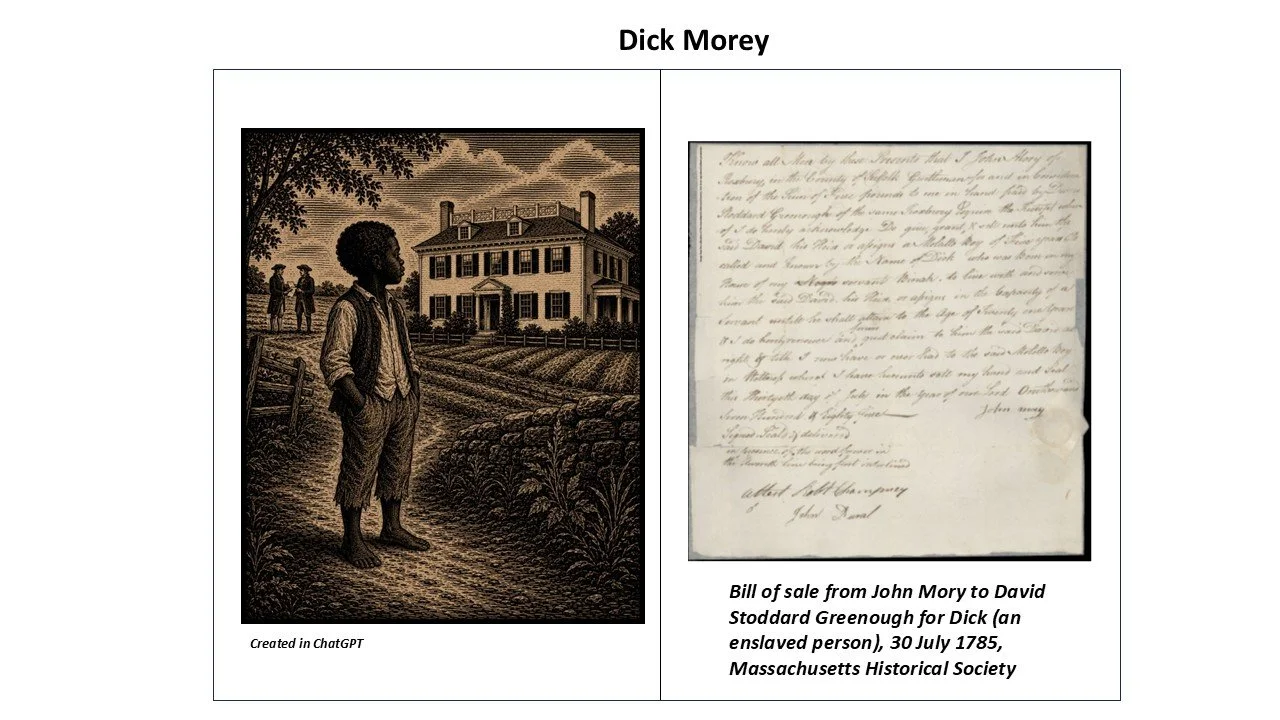
The first known record of Dick appeared when he was five years old. On July 30, 1785, John Morey sold Dick for five pounds to his former neighbor David Stoddard Greenough who lived in what is known today as the Loring Greenough House. The “Bill of Sale” clearly treated young Dick as Morey’s property, transferring him to Greenough “in the Capacity of a Servant until he shall attain to the Age of Twenty one Years.” Though born enslaved in the Morey household in 1780, Dick was referred to as indentured, not enslaved, and thus would be free when he attained adulthood.[27][28]
The 1785 bill of sale states that Dick was the son of an enslaved African woman named Binah, probably the same seven-year-old girl “Negro garl” listed as “Bino” in the estate of John Morey’s father in 1771 (see above). Dick’s mother was African, and Dick was referred to as “Molatto”, a term White enslavers often used to describe people they perceived to be of Mixed Race. It is possible that John Morey was Dick’s father. It is also possible Dick’s father might have been another man of White, Indigenous or Mixed Race. In any case, Dick had no say as to how he was identified.
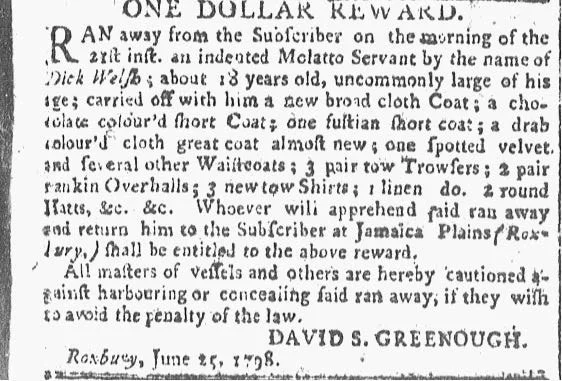
At age 18, Dick sought his freedom. Columbian Centinel, July 4, 1798
Dick worked as an indentured farm hand for Greenough from 1785 until 1798 when he sought his freedom, at that point known as Dick Welsh.[29] His escape may not have been successful because federal census records for 1790 and 1800 show one person (Dick?) in the Greenough household listed in the category “All Other Persons Except Indians Not Taxed.”[30] Dick’s indenture presumably ended in 1801 when he reached 21 years of age. Then, he most likely left the Greenough household to pursue his own life.
David Stoddard Greenough (1752-1826) was an enslaver, indenturer and member of First Church. In 1774, he inherited part of a sugar plantation in Antigua which the Greenough family owned until 1819. A 1789 inventory counted 108 people enslaved there, meaning that Greenough derived part of his wealth directly from enslaved labor.[31]
London, Othello and Phillis
Before the American Revolution, from 1760 until 1774, loyalist Joshua Loring and his family lived in the Loring-Greenough House. At least three people were enslaved by the Loring family: London, Othello and Phillis.
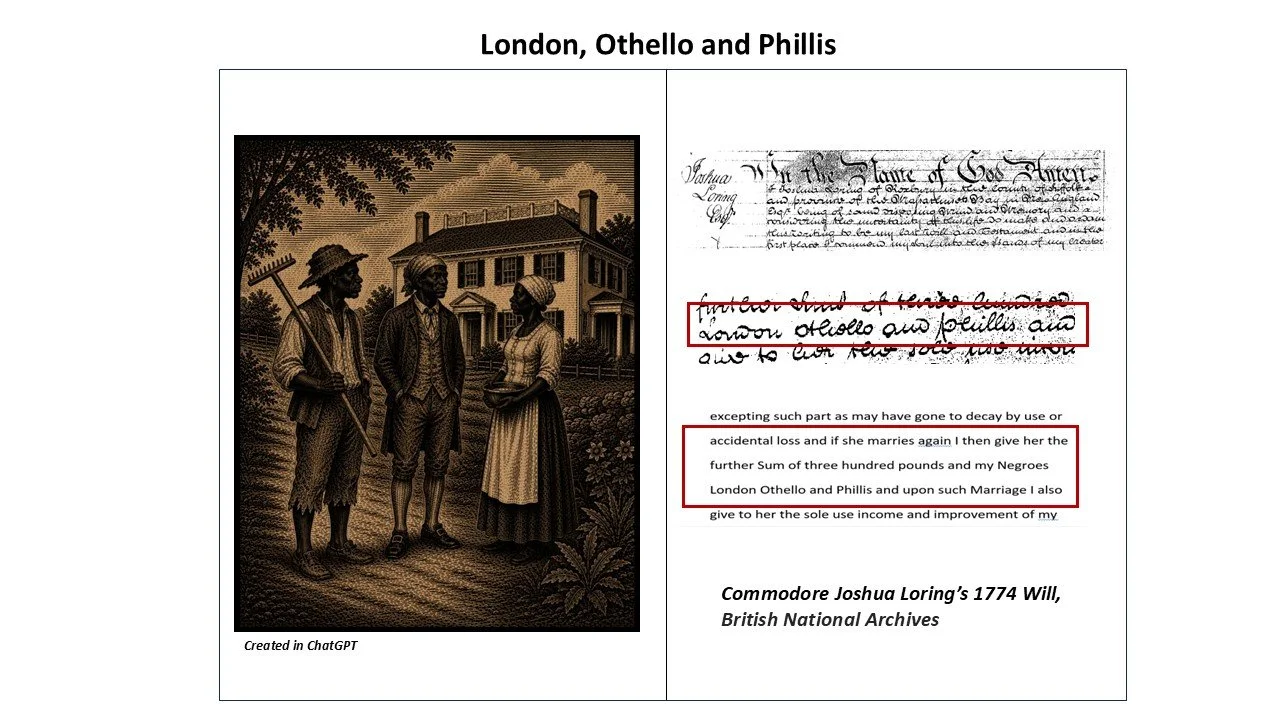
We know of London, Othello and Phillis because they were listed in Commodore Loring’s 1774 will.[32] In events leading to the Revolution, a mob attacked Loring’s Jamaica Plain home in August 1774, forcing the Lorings and presumably London, Othello and Phillis to move to the Loring’s Boston townhouse until the Lorings fled on March 17, 1776, Evacuation Day, the day the British retreated from Boston.[33]
Commander Loring wrote his 1774 will at a point at which he believed that the Revolution would not succeed and that he would remain in Massachusetts. His will explained what he would leave and what his wife would inherit under different scenarios. The will states, “… if she marries again, I then give her the further sum of three hundred pounds and my Negroes London Othello and Phillis…”.[34] Events did not unfold as Commander Loring predicted, and he and his family ended up returning to London, England, where Loring died in 1781.
London
What happened to London after the Lorings fled in 1776? Certainly, the great upheaval during the Revolutionary War may have provided him with new opportunities. He may have self-emancipated or something happened which meant that he was no longer enslaved by the Lorings. We know this because in 1783 widow Mary Loring included London in her “Memorial” inventory of her losses filed with Britain. British parliament had passed legislation approving reparations for some Loyalist losses. Along with real estate, furniture, livestock and farm implements and other property lost due to the American Revolution, Mary Loring listed “A Negro Man named London” and valued him at 50 pounds.[35] The Lorings considered London a true “loss” from the war.
Othello
There is evidence that upon Loring’s departure from Boston, Commodore Loring gave or sold Othello to his son Joshua Loring, Jr. and his wife Elizabeth Lloyd Loring.[36]
After Evacuation Day from Boston in April 1776, Joshua and Elizabeth left for New York. It seems that Joshua was living in Manhattan while Elizabeth stayed at her family home in Long Island. There, in August, Elizabeth received a letter from Loring Jr. saying, “I would not go out of town, should it prove true I shall be obliged to go to Long Island in the morning to take up all the Rebel Officers [engage in battle with the Revolutionary Army], in that case will send you word. My trunk of papers & your plate [silver] you will bring to town with you. Should I send out for you to come to town, let Othello come back with Cornelius on one of the Generals [horses].”[37]
Clearly, Othello was trusted with important papers, the family silver and a British general’s horse. What happened to Othello after the Revolution? During the American Revolutionary War, an estimated 20,000 Black individuals sought refuge or fought with the British in exchange for freedom, and approximately 3,500 of these freed Black Loyalists went to Nova Scotia.[38][39][40] Was Othello among them?
Phillis
It’s likely that Phillis ran the Loring household, both in Jamaica Plain and in the Loring’s Boston townhouse. She may have have been responsible for cooking, cleaning, laundry and more. Since the Lorings were wealthy, she might have had assistance in hauling water and heavy tasks, but perhaps not. Even if the Lorings employed an outside tailor or seamstress, Phillis may have been in charge of mending, sewing or even spinning and weaving. Not much is known about Phillis after the Lorings left Boston, but she was not considered by Mary Loring to be a “loss” from the war. Possibly the Lorings sold Phillis prior to their departure for compensation or “gifted” her to a family member as Commodore Loring did with Othello. Alternatively, Phillis may have self-emancipated during the Revolutionary War after the Lorings departed for London in 1776.
Sarah
Sarah was enslaved by Captain Timothy Penny. When Sarah sought her freedom in September 1777, Penny advertised for her return. He described her as “a Negro Woman named Sarah, she is a short Black wench about 30 years old, she is supposed to be harboured by some free negro in Boston.”[41] The free Black community of Boston was known for its mutual aid and protection of freedom seekers, and it is possible that is where Sarah began a new chapter of her life.
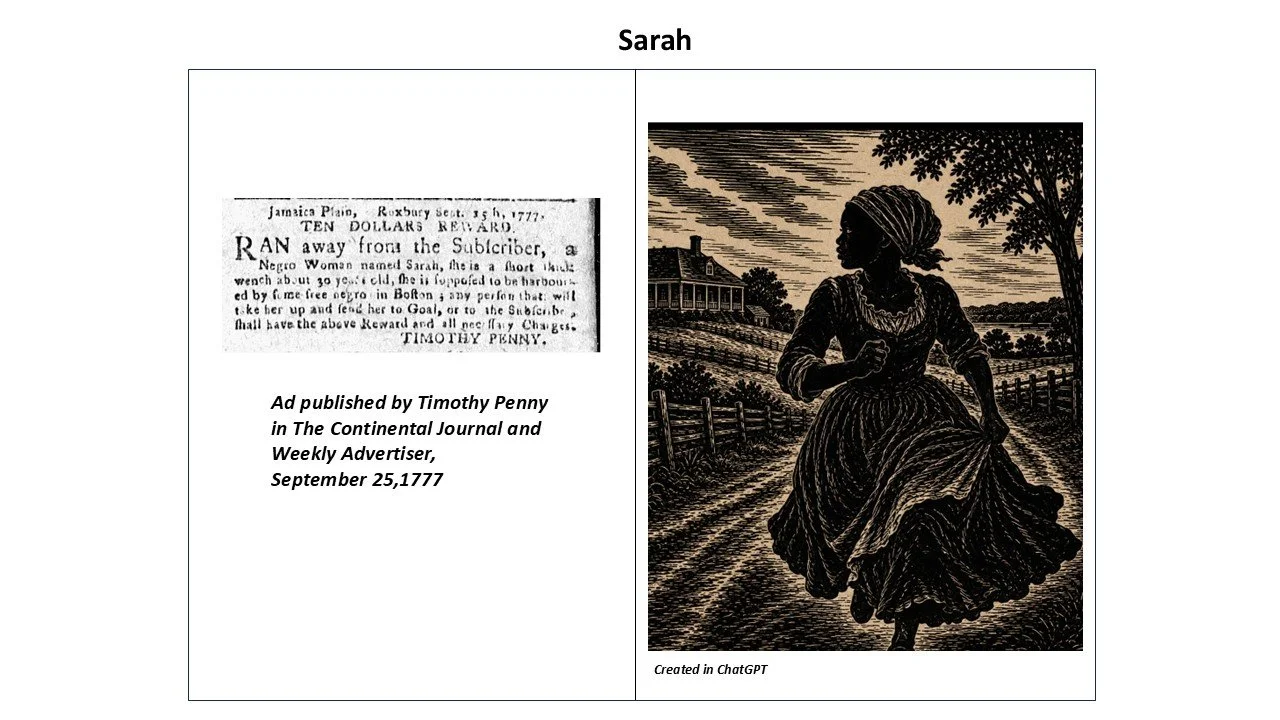
Captain Timothy Penny (1720s/30s - after 1789) was a sugar planter from Jamaica who arrived in Jamaica Plain and built a house near the pond in the late 1760s. The 1771 tax record show Penny as the owner of “Two Servants for Life.” It was common for Caribbean planters to bring enslaved people to New England. In 1774, Penny built a one-story house in the West Indian plantation style near today’s Orchard Street, where he and his family lived until they returned to Jamaica around 1789.[42]
Three Enslaved People, Names Once Known
In the early 1770s, country estates ringed Jamaica Pond. Three enslaved people are known to have lived on one of those estates on Pond Street. The 1771 tax records show Sir William Pepperrell (1746-1816) as the servant owner of “Three Servants for Life.” Pepperrell inherited most of his estate from his grandfather who enslaved around twenty people at any one time. His wife Elizabeth was the daughter of Isaac Royall and a member of the largest enslaving family in the colony.
Pepperrell rented colonial Governor Bernard’s 60-acre estate on Pond Street in Jamaica Plain after Bernard returned to England in 1769.[43] The estate contained a three-story house, greenhouse, stables and coach house. It is likely the three enslaved people were responsible for the upkeep of this large estate. Sir William Pepperrell presented a Bible to First Church for the use of the pulpit in 1772, so presumably he and his family attended the church, and possibly the three people he enslaved were required to attend as well.[7]
Pepperrell, a committed Loyalist, fled to England in 1775. After settling there, he became a leading advocate for loyalist compensation. He chaired the Loyalist Association formed in May 1779 which pushed the British Treasury to help loyalists secure compensation and pensions. Pepperrell's claim was one of the largest submitted and he received £24,415 for the loss of his Kittery property along with land in Roxbury and on Boston's Summer Street.[44] Unlike Mary Loring, Pepperrell did not list formerly enslaved people as “property” on his claim.[45] Pepperrell may have sold the three people he enslaved prior to his departure or they may have self-emancipated during the upheaval of the Revolutionary War.
Free Black People with Death Records Recorded by First Church from 1801 to 1837
The ministers of First Church in Jamaica Plain, Unitarian Universalist, recorded the deaths of eight Black people. Hidden Jamaica Plain has researched the Bridgham and Giles families and published a chronology in a separate article, “From Slavery to Freedom: Three Centuries of a Black Family in Jamaica Plain.”
It is not known whether any of the following free Black people were buried in the First Church’s Burying Ground on Eliot Street in Jamaica Plain.
Peter Bridgham
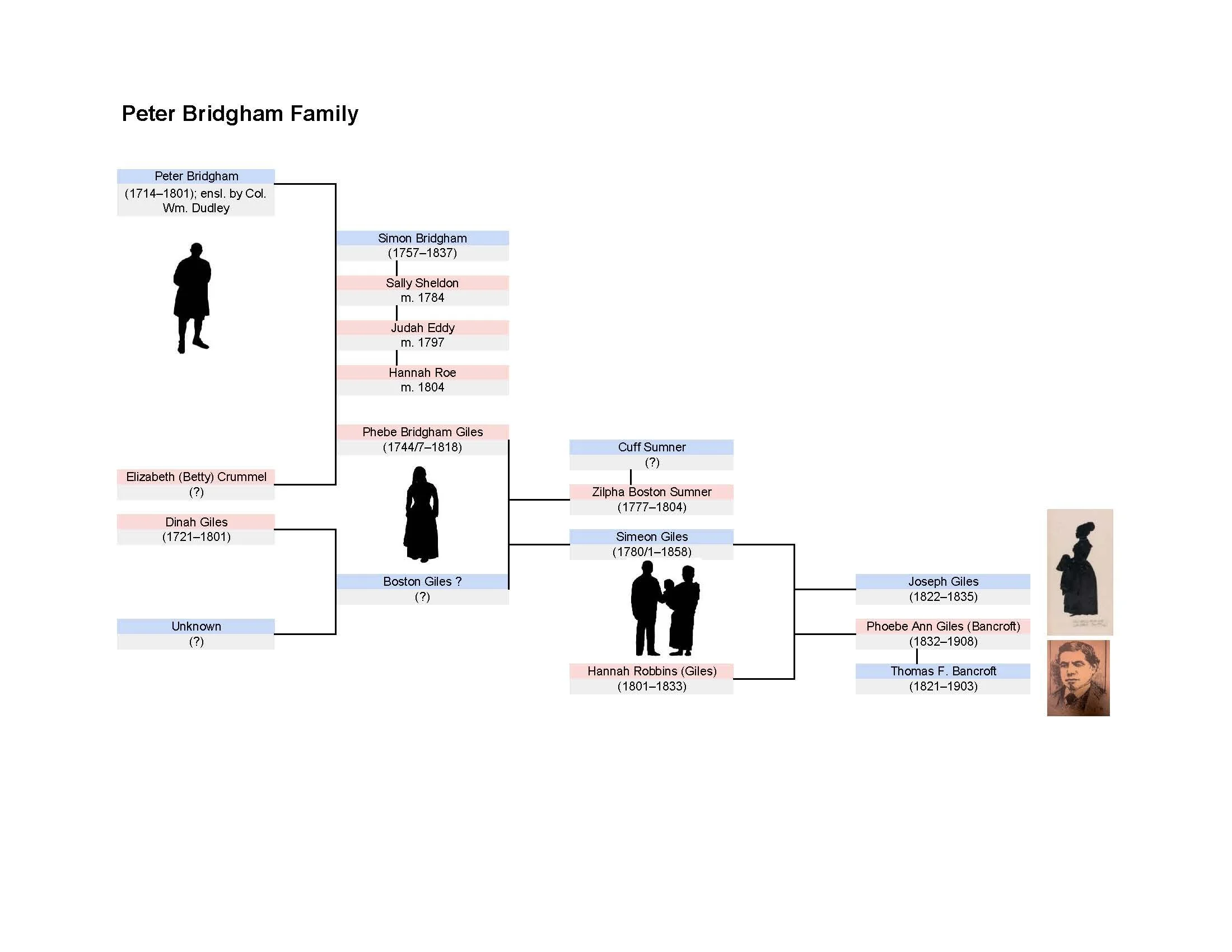
Peter Bridgham was born around 1714 and died on December 1, 1801. We know of him because First Church’s Rev. Thomas Gray entered his death into the church records as “a negro aged 87 of “Old age.’” Peter was living in Jamaica Plain by 1743, enslaved by Colonel William Dudley. While enslaved, he married Betty Crummel in 1741 and they had three children: Phebe, born 1744, Peter born 1754, and Simon, born 1759. In 1743, Col. William Dudley died and his estate was probated and Peter was valued at 170 pounds.[46] In 1750, seven years later, he was sold to an unidentified buyer for 300 pounds.[47]
Sometime between 1750 and 1772, Peter became a free man. In his 1799 will, he described himself as a laborer and, apparently, he saved his money. In August 1772, Peter purchased a quarter acre of land from John Morey (1738-1800) on what is now Centre Street, a parcel that is currently part of the Arnold Arboretum. He also worked or owned another 12-acre parcel in the area. He and his family are listed in the 1790 and 1800 federal censuses.
Phebe Giles
Peter’s and Betty’s daughter Phebe was born in 1744 and died on April 17, 1818, recorded by Rev. Thomas Gray as “(a black) aged 71 of Bilious Cholick” [a gallstone attack].
In 1776, Phebe married a man named Boston [Giles] when she was about 32 years old. The marriage certificate indicates that both Phebe and Boston were free at that time. Phebe seems to have used both the last names of “Boston” and “Giles.” In 1777, Phebe and Boston had a daughter named Zilpha Boston[48] and three years later, in 1780, they had a son named Simeon Giles.
In 1801 upon Peter Bridgham’s death, Phebe inherited the majority of her father’s estate and was appointed his executor.[49]
Simon Bridgham
Peter’s and Betty’s son Simon was born in 1759 and died on December 3, 1837. First Church’s minister George Whitney entered his description in the records as “a (colored man) aged 80 of Old age.”
No information has been found to date about Simon’s occupation or other activities. However, three marriages or marriage intentions were recorded for Simon: in 1784, when Simon would have been approximately 25 years old to Sally Sheldon[50]; in 1797 at 38 years old to Judah Edey[51]; and in 1804 at 45 years old to Mrs. Hannah Roe.[52] Simon Bridgham was listed in the 1810 and 1830 Federal censuses. He was listed as head of household for five and seven members, respectively. It is possible that Simon’s marriage to Judah Edey produced a son named David Bridgham.
David Brigham
Based upon his death record at First Church, David “Brigham” was born around 1799. He may have been the son of Judah Edey and Simon Bridgham. David died of cholera on October 22, 1832 at the age of 33, noted in the church records by Rev. Thomas Gray.[53]
Hannah Brigham
Simon Bridgham’s third wife was Mrs. Hannah Roe. When they married in 1804, Hannah was about 20 years old and took on Simon’s last name. They presumably lived together for the next 30 years. She predeceased him, dying on June 13, 1834. Rev. Thomas Gray noted in the church records that she was “a black, aged 50 years, of Inflammation of the windpipe” and that she was buried on Sunday, June 15, 1834. It is not known where she was buried.
Joseph Giles
Joseph was the great-grandson of Peter Bridgham and Betty Crummel, the grandson of Phebe Bridgham and Boston Giles, and the son of Simeon Giles and his wife Hannah Robbins. In 1822, Hannah gave birth to Joseph, likely named for her father. Tragically, Hannah died in 1833. Simeon and 11-year-old Joseph continued their lives in Jamaica Plain but, sadly, two years later in 1835, the family experienced a second tragedy. Joseph died at age 13 of “Typhus Fever.” Minister George Whitney noted his death in the church records as “Died, June 24, 1835, Joseph, Son of Simeon Giles, aged 13 yr. (a black) of Typhus fever. Buried Sunday afternoon the 28th.” It is not known where Joseph was buried.
Othello Cutler
Othello Cutler was born around 1767 and likely lived in Jamaica Plain. It is possible that Othello Cutler took the surname “Cutler” from a Cutler family he was enslaved by or worked for or that he chose it himself as a free man. We do know that Benjamin Clark Cutler, a Boston merchant and sheriff of Norfolk County, died at his residence on Centre Street in Jamaica Plain in 1810 at age 54, two years before Othello, but nothing is known about their relationship.[54] Rev. Thomas Gray wrote in the church records, “Died, July 10, 1812, Othello Cutler, a negro aged 45 of Dropsy [fluid retention often a sign of heart or kidney failure].”
Hannah Thomas
Hannah Thomas was born into freedom, around 1813 and died on May 14, 1835. It is likely that she lived in Jamaica Plain. She is recorded with a first and last name, a documentary pattern consistent with that of an independent free person. Rev. George Whitney recorded at First Church, “Hannah Thomas, (a black) aged 22 years of Lung Fever [pneumonia]. Buried Saturday afternoon, the 16th.” It is not known where Hannah was buried.
Othello Cutler’s and Hannah Thomas's near-invisibility is characteristic, not exceptional. Massachusetts did not require statewide civil registration of vital events until 1841, six years after Hannah’s death. Before that, recording depended on individual town clerks and on the churches. Black residents – especially free, working people without property – were inconsistently recorded, frequently only at death, and often only through a church minister's ledger.
We know of these people either through their own actions or from church records:
Prince, London and others self-emancipated
Sarah sought protection in Boston’s Black community
Dick Morey/Welsh rejected his indenture
Peter Bridgham acquired land
Phebe Boston/Giles administered an estate
Cato Morey helped found the African Society to pool resources for education, mutual aid and civil rights
It is possible that any of these people could have attended First Church in Jamaica Plain and sat in the five segregated pews for Black attendees.
This article was written by volunteer researchers associated with the Hidden Jamaica Plain project and is based on materials available at the time of publication. Information may change as research continues and more materials are uncovered.
End Notes
[1] Annals and Reminiscences of Jamaica Plain by Harriet Manning Whitcomb, Riverside Press, Cambridge, 1897. https://babel.hathitrust.org/cgi/pt?id=loc.ark:/13960/t3902c94p&seq=11&q1=there+were+five+narrow+long+pews
The remarks in brackets “[for the colored people, several of them slaves]” were added by Whitcomb.
[2] Original church description is from Rev. Dr. Thomas Gray's 50-year anniversary address at the First Church in Jamaica Plain Half-Century Sermon: Delivered on Sunday Morning April 24, 1842, at Jamaica Plain available on https://books.google.com/
[3] https://www.jphs.org/people/2005/4/14/harriet-whitcomb-a-grande-dame-and-raconteur.html#gsc.tab=0
[4] Massachusetts Constitution and the Abolition of Slavery https://www.mass.gov/guides/massachusetts-constitution-and-the-abolition-of-slavery#:~:text=It%20is%20generally%20agreed%20that,participated%20in%20the%20slave%20trade
[5] African American Heritage in Massachusetts http://www.africanamericanheritagemassachusetts.com/
Black Lives, Native Lands, White Worlds: A History of Slavery in New England, Jared Ross Hardesty, University of Massachusetts Press, 2019, p. 140
[6] https://www.jphs.org/colonial-era/slavery-in-jamaica-plain#gsc.tab=0
[7] The Town of Roxbury by Francis S. Drake, 1878
[8] https://firstchurchjp.org/about-us/history/
[9] https://www.uuum.org/scourge-of-slavery
[10] https://oldnorth.com/blog/upper-level-gallery/
[11] https://www.youtube.com/shorts/BFl99pFCbb4
[12] Congregational Library & Archives, “Black & Indigenous Research Guide,” https://congregationallibrary.org/black-indigenous-research-guide (updated March 25, 2026).
[13] National Park Service, “Black Churches of Beacon Hill,” https://www.nps.gov/articles/000/black-churches-of-beacon-hill.htm
[14] The Colonial Roots of American Taxation, 1607-1700
https://www.hoover.org/research/colonial-roots-american-taxation-1607-1700
[15] “John Adams, Political Moderation, and the 1820 Massachusetts Constitutional Convention: A Reappraisal.” Author: Arthur Scherr, Historical Journal of Massachusetts, Volume 46, No. 1, Winter 2018, pp. 114-159
[16] https://en.wikipedia.org/wiki/Separation_of_church_and_state_in_the_United_States
[18] Ad published by Eleazer Weld in the Boston Evening Post on February 1, 1769 and the Boston Post Boy March 12, 1769
[19] Suffolk County, MA: Probate File Papers. Case #14993 John Morey. FamilySearch.org https://www.familysearch.org/ark:/61903/3:1:3Q9M-CS27-3S73-X?i=1225&cat=2822393
[20] https://www.masshist.org/database/viewer.php?item_id=573&pid=42
[21] AmericanAncestors.org: Boston, MA: Taking Records 1800, Transcribed by David Allen Lambert, NEHGS Chief Genealogist, from original volumes held by Boston Public Library
[22] AmericanAncestors.org: Boston, MA: Church Records, 1630-1895, Volume: King’s Chapel, Page 290
[23] Slavery and King’s Chapel in the 19th Century
https://www.kings-chapel.org/uploads/1/2/3/9/12399624/kings_chapel_slavery_report.pdf
[24] Land transfer for Morey to Bridgham 1772, 1774
images, FamilySearch (https://familysearch.org/ark:/61903/3:1:3QS7-99Z3-98VY?cc=2106411&wc=MCB5-2Z9%3A361613401%2C362200001 : 22 May 2014), Suffolk > Deeds 1773-1775 vol 124-126 > image 379 of 874; county courthouses and offices, Massachusetts.
[25] Seeking John Morey in Roxbury, Boston 1775 blog by J.L. Bell, November 11, 2022 https://boston1775.blogspot.com/search?q=john+morey
[26] Family Search, 1783 Deed https://familysearch.org/ark:/61903/3:1:3QSQ-G9Z3-SZCY?cc=2106411&wc=MCB5-G3J%3A361613401%2C362209302
[27] Massachusetts Historical Society, Bill of sale from John Mory to David Stoddard Greenough for Dick (an enslaved person), 30 July 1785 https://www.masshist.org/database/669
[28] Dick Morey “in the Capacity of a Servant,” Boston 1775 blog by J.L. Bell, November 11, 2022 https://boston1775.blogspot.com/2022/11/dick-morey-in-capacity-of-servant.html
[29] Ad, Columbian Centinel (Boston, Massachusetts) XXIX, no. 35, July 4, 1798
[30] 1790 Federal Census, 1800 Federal Census, 1810 Federal Census
[32] Joshua Loring Will, Probate 11-1084-7, Public Record Office, The National Archives of Britain
[33] Eva Phillips Boyd, “Commodore Joshua Loring, Jamaica Plain by Way of London,” Old Time New England magazine, April-June 1959 as reprinted by the Jamaica Plain Historical Society
[34] Joshua Loring Will, Probate 11-1084-7, Public Record Office, The National Archives of Britain
[35] Eva Phillips Boyd, “Commodore Joshua Loring, Jamaica Plain by Way of London,” Old Time New England magazine, April-June 1959 as reprinted by the Jamaica Plain Historical Society
[36] Elizabeth Lloyd Loring married Commodore Loring’s son Joshua Jr. and they lived in Dorchester.
[37] Revolutionary Ladies by Philip Young, Alfred A. Knopf, 1977
[38] https://en.wikipedia.org/wiki/African_Americans_in_the_Revolutionary_War
[39] https://blackloyalist.com/loyalist-history/
[41] Continental Journal, and Weekly Advertiser (Boston, Massachusetts), no. LXX, September 25, 1777: [4]. Readex: America's Historical Newspapers.
[42] https://www.jphs.org/colonial-era/slavery-in-jamaica-plain/#end-notes&gsc.tab=0
[43] https://www.jphs.org/colonial-era/slavery-in-jamaica-plain#gsc.tab=0
[44] Colin Nicolson and Stuart Scott, "A 'Great National Calamity': Sir William Pepperrell and Isaac Royall, Reluctant Loyalists," Historical Journal of Massachusetts, Vol. 28, No. 2 (Summer 2000), published by Westfield State University's Institute for Massachusetts Studies. Full text: https://www.westfield.ma.edu/historical-journal/wp-content/uploads/2018/06/Nicolson-and-Scott-summer-2000-combined.pdf
[45] Ancestry.com. UK, American Loyalist Claims, 1776-1835, AO 12-13, The National Archives of the United Kingdom
[46] Wm. Dudley probate inventory— Suffolk County Probate Records, vol. 42. p. 333. https://www.familysearch.org/ark:/61903/3:1:3Q9M-C9YT-Q15
[47] Wm Dudley probate file, p. 28—sale of Peter for 300 pound - Suffolk County, MA: Probate File Papers.Online database. AmericanAncestors.org. New England Historic Genealogical Society, 2017-2019. (From records supplied by the Massachusetts Supreme Judicial Court Archives. Digitized images provided by FamilySearch.org) https://www.americanancestors.org/DB2735/rd/48705/7943-co28/1416817444
[48] Zilpha Boston's marriage is listed under the marriage record of her parents, Phebe and Boston, Vital Records of Roxbury, Vol. 2, pg. 449 "BOSTON, Zilpha, and Cuff Sumner, Nov. 4, 1801" Her birth date of 1777 is calculated by the date of her death in 1804 at the age of 27
[49] Peter Bridgham’s will - Norfolk County, MA: Probate File Papers, 1793-1877. Online database. AmericanAncestors.org. New England Historic Genealogical Society, 2019. (From records supplied by the Massachusetts Supreme Judicial Court Archives. Digitized mages provided by FamilySearch.org) https://www.americanancestors.org/DB2739/t/51352/2510-co4/1421047490
[50] Massachusetts, State Vital Records, 1638-1927 "Massachusetts, State Vital Records, 1638-1927", FamilySearch(https://www.familysearch.org/ark:/61903/1:1:FCQT-SQZ : Thu May 23 01:48:49 UTC 2024), Entry for Simon Bridgham and Sally Sheldon, 3 Oct 1784.
[51] p. 469 Boston, MA: Inhabitants and Estates of the Town of Boston, 1630-1822 (Thwing Collection). Inhabitants and Estates of the Town of Boston, 1630–1800 and The Crooked and Narrow Streets of Boston, 1630–1822. CD-ROM. Boston, Mass.: New England Historic Genealogical Society, 2001. (Online database. AmericanAncestors.org. New England Historic Genealogical Society, 2014.) https://www.americanancestors.org/DB530/rd/14226/3783/260086594
[52] p.46 Massachusetts: Vital Records, 1620-1850 (Online Database: AmericanAncestors.org, New England Historic Genealogical Society, 2001-2016). https://www.americanancestors.org/DB190/rd/7788/46/141322864
[53] Vital records of Roxbury, Massachusetts, to the end of the year 1850, v.1, p. 681 (C.R .3)