
History of 55 South St: The Early Years
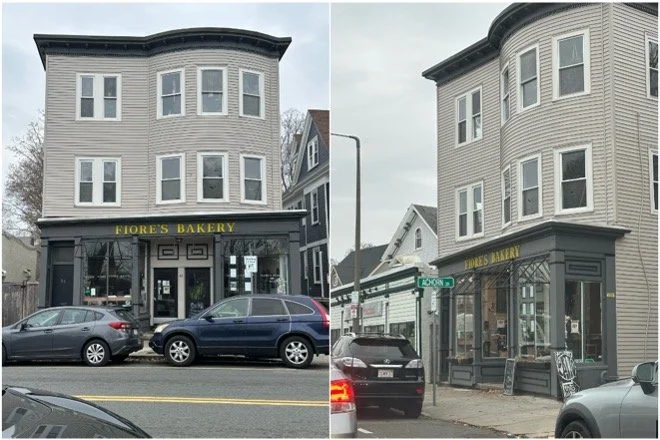
55 South Street, Jamaica Plain
In December 2025, the property at 55 South Street, Jamaica Plain — the home of Fiore’s Bakery — was placed on the market. Anticipating that the multi-use building will take its next steps in the future, I became curious about its past, particularly the history of the businesses that have operated in its storefront and the people who lived and worked there after it was first constructed. What follows is the history of 55 South Street in its early years.
55 South Street (figure 1) was built in 1901 by jeweler William A. Neilson, and designed by architect Cornelius A. Russell. The three-story, wooden building is framed using mortise-and-tenon joints. It has a flat roof and a stone foundation. Modern siding is likely hiding some of the original architectural detail of the building, so it is difficult to definitively identify its architectural style. However, it could be considered Classical Revival, based on Russell’s other designs. Some of the visible details on 55 South Street include a semicircular bay, brackets along the roofline, and dentils underneath the roof cornice and the cornice of the first-floor display windows. There are also rectangular panel moldings above the front doors, along the doorways, and above and below the display windows. The two front doors on the first floor have been present since the building's construction, as indicated by a 1902 license to operate an apothecary in the retail space.
Acquiring the Land and Permit to Build
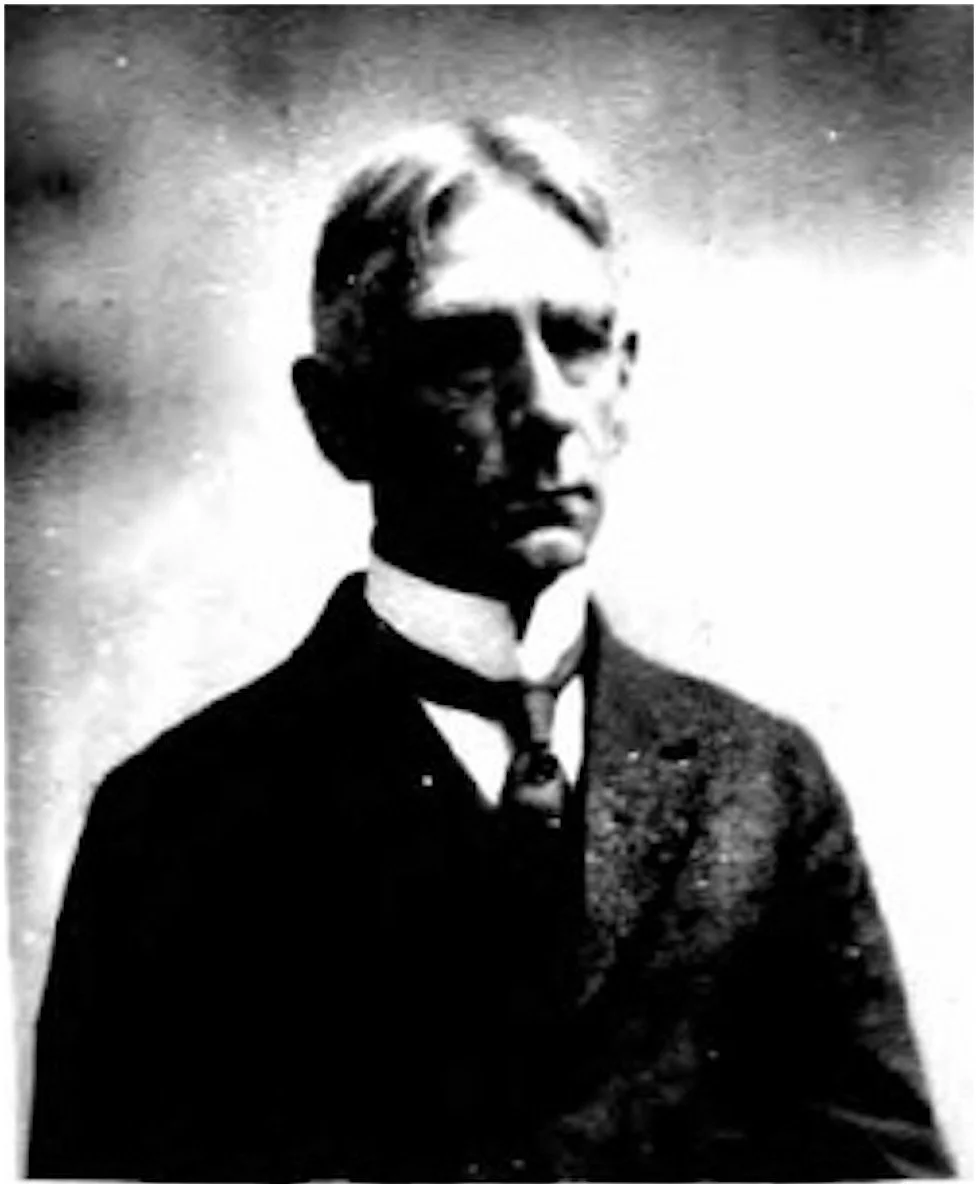
Edgar O. Achorn
In 1900, William A. Neilson purchased the land at 55 South Street, and the lot directly behind it, from John Warren Achorn, a physician who lived and practiced in Trinity Court in Boston. Achorn was also an author of medical books and essays. The deed indicates that “J. Warren Achorn” conveyed land and a cellar thereon, perhaps the cellar underneath Fiore’s Bakery. The deed required Neilson to keep a certain passageway and turnaround open for use by carriages, and for other purposes. That passageway is the extant Achorn Circle, which runs along the right-hand side of 55 South Street; it is presumably named after an earlier landowner, Edgar Oakes Achorn (figure 2), a lawyer and Brookline resident who practiced law at 27 Tremont Row in Boston. Edgar O. Achorn, the brother of John Warren Achorn, served as a counselor for the Swedish consulate in Boston and as the secretary to the Embassy at St. Petersburg, Russia. He was also a member of the New-England Historic Genealogical Society and the Boston Art Club.
Neilson filed the permit to build a multi-use structure at 55 South Street (formerly 53 South Street) on March 4, 1901. The permit indicated it would be a three-story building with a store on the first floor and two dwelling units above. In September 1902, Neilson purchased the two adjacent lots, one at 53 South Street and the lot behind it, on Achorn Circle, from Guy W. Mitchell, along with the buildings thereon, after those properties were auctioned off earlier in the year for non-payment of taxes; Neilson now owned all four properties around Achorn Circle. That year, he filed a permit to build a two-and-a-half-story dwelling at 53 South Street, which was also designed by Cornelius A. Russell. Rental ads in 1901 and 1902 advertised that it was a “fine location” near the Soldiers’ Monument, cars, and the public library.
Architect, Cornelius A. Russell

Signature of Cornelius A. Russell
Cornelius A. Russell was a Nova Scotia-born architect who designed buildings in the Jamaica Plain, Roxbury, Mission Hill, and Dorchester neighborhoods of Boston, as well as in the municipalities of Chelsea, Brookline, Duxbury, and Manchester, in the late 19th and early 20th centuries. His work included single-family houses, double houses, three-deckers, and apartment blocks. In addition to 55 South Street, Russell designed other buildings in Jamaica Plain, including the adjacent Queen Anne-style house at 53 South Street (1902), and the wooden Queen Anne/Shingle-style “Double” three-decker apartment at 801 Centre/6 Holbrook Street (1896, figure 4). He also designed the brick Georgian Revival apartment block at 11-21 Grovenor Road/12-14 Pond Street (1902, figure 5), where Russell lived during 1905 until at least 1914. His office was located at 54 Warren Street in Roxbury at the time that he designed 55 South Street.
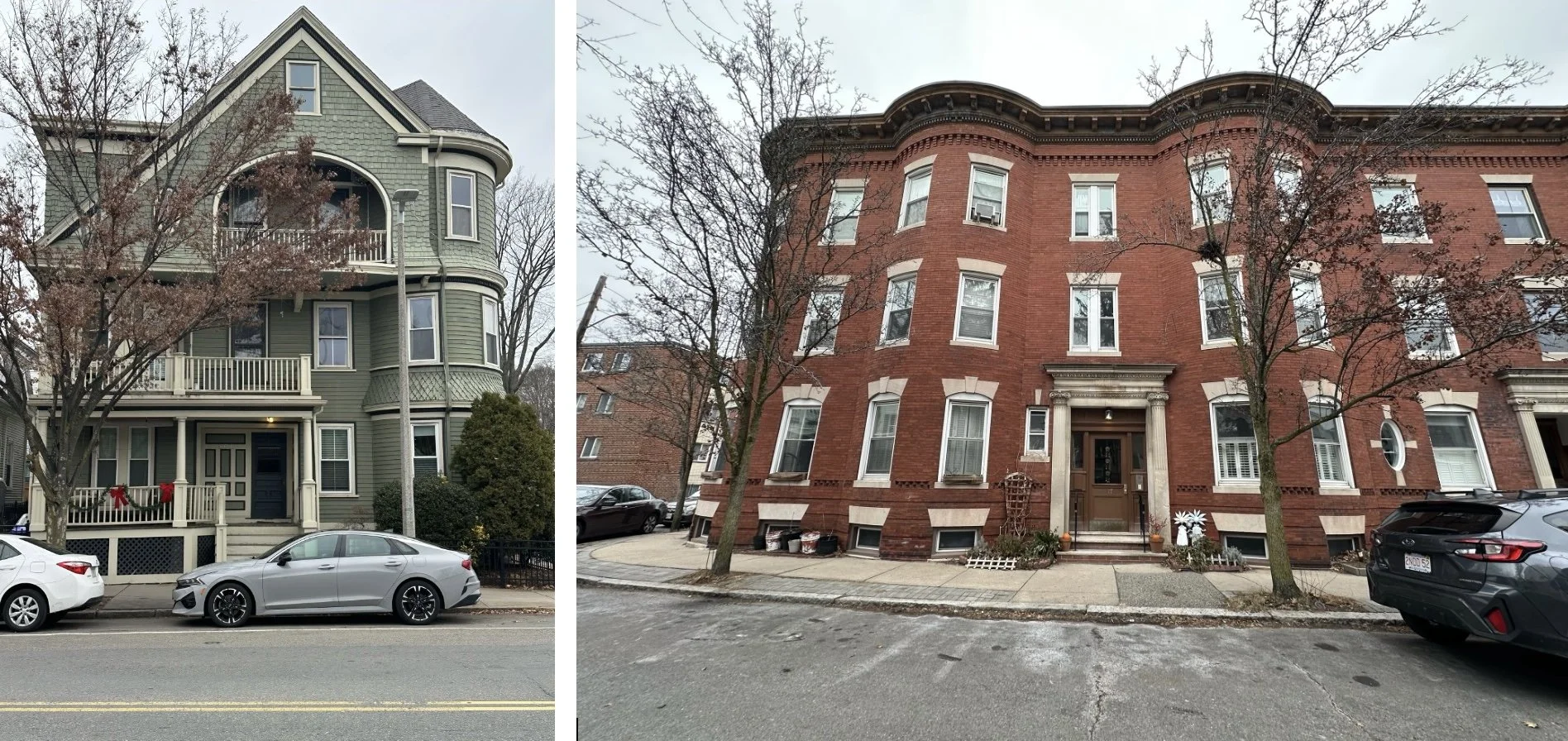
801 Centre and 11-21 Grovenor
Several of Russell’s buildings are listed in the National Register of Historic Places. They include the single-family house at 4 Aspen Street (1890) within the Mount Pleasant Historic District in Roxbury (which looks very similar to the house at 53 South Street, Jamaica Plain); the Classical Revival brick Goldsmith Block (1892) at 41 Ruggles Street/746-750 Shawmut Avenue in Roxbury; and the Classical Revival brick and wooden residential hotel in Codman Square, known as Walton Hall and Roslin Hall (1897), at 702-726 Washington Street/3-5 Walton Street. According to the Massachusetts Historical Commission’s survey on Walton Hall and Roslin Hall, Russell designed in the Classical Revival and Romanesque Revival styles.
The Original Owner, William A. Neilson
William Amada Neilson, the owner who had 55 South Street constructed, was born in Boston on June 6, 1856, to William Neilson, a jeweler and native of Scotland, and Abby Neilson, a native of Rhode Island. William A. had two sisters, Laura A. and Jeanette (“Jeanie”).
William A. Neilson’s father operated a jewelry store at 891 Washington Street in Boston. After William Sr. died in 1891, William A. took over the business. William A. maintained his family’s business at 891 Washington Street until at least 1905, and appears to have continued to work as a jeweler until his retirement in 1915.
Neilson, who remained unmarried, lived at 33 Sawyer Avenue in Dorchester with his two sisters beginning in 1893 or 1894. He lived there while he owned 55 South Street, and remained at the Sawyer Avenue house until his death on October 20, 1916, at the age of 60.
After Neilson died in 1916, ownership of 55 South Street transferred to his sister, Laura A. Neilson. She owned the property until 1921, when she sold it to George W. Douglass, who owned the apothecary business on the ground floor.
Early Residents of 55 South Street
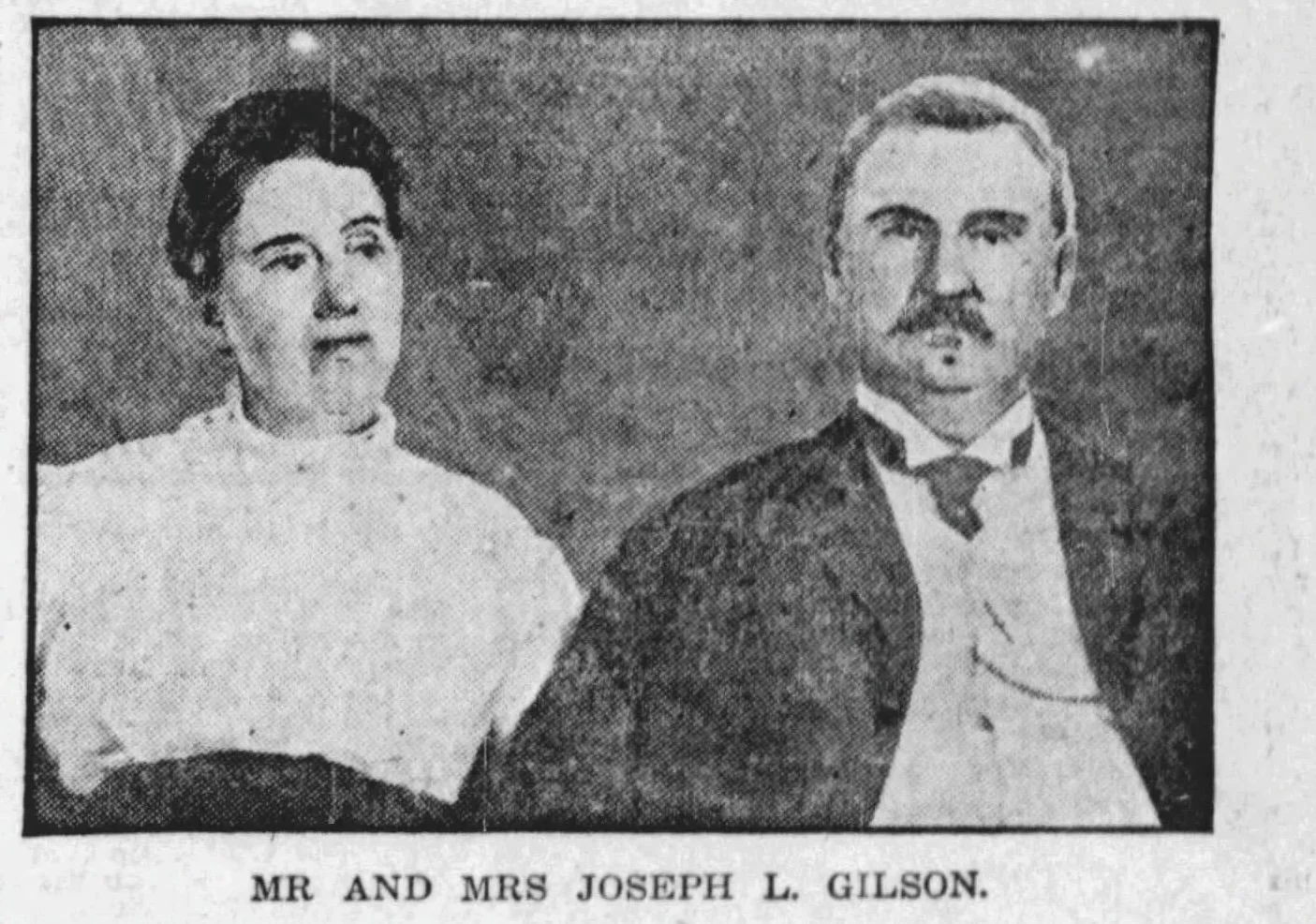
Hannah J. and Joseph L. Gilson, 1906
Records point to a few of the early residents who lived in the two dwelling units above the storefront at 55 South Street. In 1902, Mrs. Olive C. Lee and her husband lived at 55 South Street. That same year, but presumably in the other unit, lived Hannah J. and Joseph Lee Gilson (figure 6) and their children. The 1910 census shows that the Gilsons’ children, Florence A., Earl M. and Horace M., lived at 55 South Street as well.
Joseph Lee Gilson was born in February 1858 in Perry, Maine. His wife, Hannah J. McCormick, was born in Pembroke, Maine in December 1855. The couple married in 1882, and moved to Jamaica Plain in 1891. Together they had five children: four sons and one daughter.
Joseph L. Gilson worked for the Boston Elevated for at least 15 years. By 1906, he was stationmaster at North Station, and by 1909 he was working as a motorman for the railroad. A Boston Globe article from October 6, 1906 stated that the couple observed their 15th “silver” wedding anniversary at 55 South Street, with many of Joseph’s Elevated colleagues present: “It was a joyous occasion, many friends of the couple dropping in during the evening to extend their congratulations and best wishes...Many of [Joseph’s] associates on the Elevated were on hand to assist in the occasion and they kept the fun going all evening. Many beautiful silver presents were received as reminders of the esteem of their friends” (p. 5).
The Gilsons lived at 55 South Street until at least 1915. Joseph died on September 2, 1916, at the age of 58. Hannah died in Roslindale on February 8, 1918, at the age of 62.
The First Business: Arthur A. Stinson’s Apothecary
In 1902, the year after 55 South Street was constructed, Arthur A. Stinson opened his apothecary in the building’s first-floor storefront. That year, Stinson applied for a license to practice as a druggist at that location. The newspaper notice indicated that the store had two doors, a side door at Achorn Circle, and a rear entrance to the cellar. By 1903, Stinson lived at 2 Achorn Circle, in the house behind the apothecary.
Arthur Abner Stinson was born in St. Andrew, New Brunswick, Canada on February 22, 1866, to Mary and John Stinson. He became a U.S. citizen in 1888. The following year, he married Elizabeth A. Fiske of Ashland, Massachusetts. The couple had two children, Arthur F. and Irene M. Later in their marriage, Elizabeth taught music out of their homes in Roxbury and Lynn.
By 1893, Arthur A. Stinson was operating a drug store on Lewis Street in Lynn, Massachusetts. By 1897, he was working at an apothecary at 50 Ocean Street in Lynn. And by 1899, he and his family were living in Boston, where he worked as a druggist at the Dale Street Drug Store at 2698 Washington Street in Roxbury.
In 1900 and 1901, Stinson hawked a “positive and guaranteed” cure for asthma in The Boston Globe, promising that “[p]ersons suffering from asthma will learn something to their advantage by sending their names and address to Arthur A. Stinson 2698 Washington St, Roxbury, MA” (November 25, 1900, p. 20). Despite his business endeavors, he filed for bankruptcy in 1900, leaving no assets.
In 1902, Stinson opened his next apothecary shop at 55 South Street, Jamaica Plain, while living at 4 Kingsbury Street in Boston. In November of 1903, he got a scare late at night. At 11:30 p.m., shortly after closing the shop for the night, two boys broke the glass gum machine at the front of the store. Believing that burglars were trying to break into his store, he phoned the police at Station 13. Patrolmen McDonald and Frazier identified the perpetrators and obtained arrest warrants. One turned out to be “E. Gilson,” likely Earl Gilson, the twelve-year-old boy who lived in one of the residential units above the store. Earl and his friend were brought to court and fined $5 each.
In 1903, Stinson filed for bankruptcy for a second time. The next year, he closed his apothecary at 55 South Street and briefly worked as a claim agent before returning to his career as a druggist. Stinson died on March 2, 1922, in Lynn, at the age of 56.
The Second Business: The G.W. Douglass Pharmacy
By 1906, another drugstore opened on the ground floor of 55 South Street, named the G.W. Douglass Pharmacy. The pharmacy was owned and managed by George W. Douglass.
George W. Douglass was born in Cambridge, Massachusetts, in 1862 to Mary J. (Marvin) Douglass, a native of Canada, and Harrison Douglass, a native of New York. George was one of at least five children. He graduated from Colgate University in 1888 and served as president of the Alumni Association.
On September 10, 1894, Douglass married Annie B. Proctor in Boston. He began working as a druggist in either 1893 or 1894, the year of their wedding. The couple lived at 198 St. Boltoph Street, Boston, from 1905 to 1907, then moved to 798 Centre Street in Jamaica Plain (1908), and finally to 34 Sedgwick Street (1919).
In 1907, a year after opening his drug store at 55 South Street, Douglass applied for a license to sell intoxicating liquors as a druggist at that location and the “side entrance” at Achorn Circle. He applied to sell liquor in the two rooms on the first floor, with the cellar to be used solely for storage. A few advertisements give a glimpse into the types of products Douglass sold at his pharmacy, including Dr. Daniel’s Dog and Cat Medicines; Nujol, a mineral oil laxative; and Lowney’s Chocolates.
In 1921, George purchased 55 South Street from Laura A. Neilson. By 1924, each of the four buildings surrounding Achorn Circle had a different owner. George W. Douglass continued to operate his drug store at 55 South Street until 1925. In 1926, Christopher P. Kevorkian purchased 55 South Street from Annie Douglass (who was conveyed the property by her husband in 1923). The Kevorkian family continuously owned 55 South Street until 1984.
In 1928 or 1929, George and Annie Douglass moved to Gloucester and opened a drugstore there. Annie Douglass died on December 17, 1931, at 59 years of age. George W. Douglass died on July 31, 1946, at the age of 84.
The Later Years
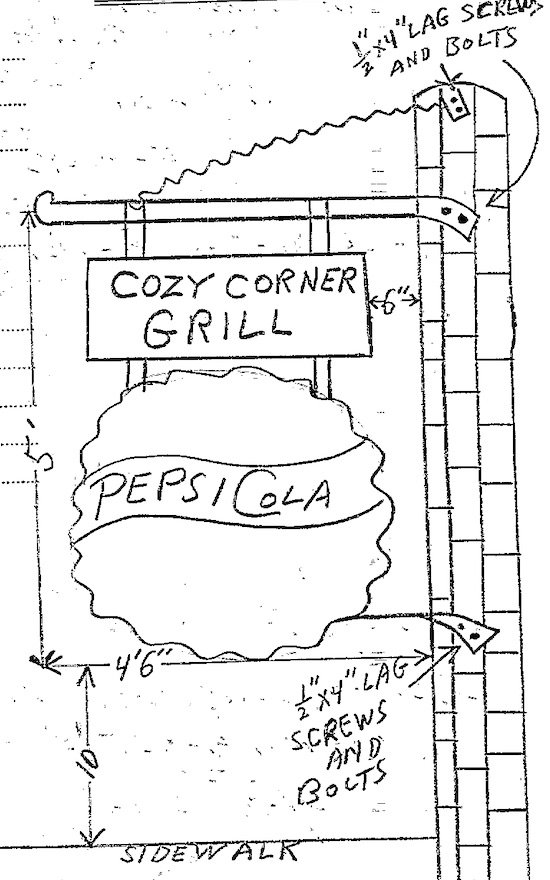
Proposed sign for the Cozy Corner Grill in Jamaica Plain, 1955
Building permits, newspaper articles, and city directories reveal additional businesses that operated on the ground floor of 55 South Street after the G.W. Douglass Pharmacy closed. They included: a retail grocery store (sometime between 1934 and 1939, until 1948) owned by Bessie M. Roome; the Cozy Corner Grill (1954-1963, figure 7) owned by Catherine A. (Remondi) Burdick; a brief change in occupancy into a residential unit (1983-1985); Arborway Video and Sound (at least 1986-1995); Thar Treasures, a store that sold decorative textiles, paintings, and brass and wood carvings from India (at least 1996-2000); and Fiore’s Bakery (2004 until present).
This building has been sitting at the beating heart of South Street for 125 years. Walk in and you can feel the history while you enjoy a sandwich or baked goods. I recommend the oatmeal raisin cookies.
January 2026
Sources
Ancestry.com
Boston Landmarks Commission. Building Information Form, McDougall, Samuel J. Three Decker (1983). BOS. 8897.
Boston Landmarks Commission. Building Information Form, Russell, Cornelius A. Apartment House (1983). BOS. 10089.
City of Boston, Assessing Online
Boston Inspectional Services Department
Jamaica Plain Historical Society, historic maps
Massachusetts Historical Commission. Inventory Form B, Walton Hall and Roslin Hall (2009). BOS. 15942.
Norman B. Leventhal Map and Education Center
Newspapers.com
Secretary of the Commonwealth of Massachusetts, Corporations Division, Business Entity Database
Suffolk Registry of Deeds
Figures
(1, 4, and 5) Photographs by Jenny Nathans
(2) Find a Grave.org, photograph provided by Grave Gremlin
(3) Boston Inspectional Services, from the original building permit for 53 South Street, Jamaica Plain
(6) Newspapers.com, The Boston Globe, October 6, 1906, p. 5
(7) Boston Inspectional Services, from a permit for ordinary repairs and minor alterations for 55 South Street, Jamaica Plain